The Longest-Range Sniper Rifles of 2026, Ranked
The Barrett M82 reaches an effective range of 1,800 meters in .50 caliber, the longest of any sniper rifle in our database.
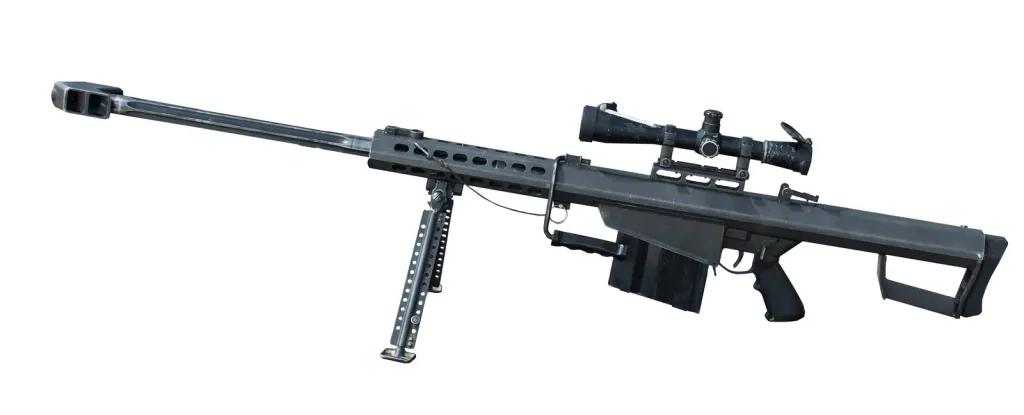
Via Wikipedia, Barrett M82 (shown for identification)
The Barrett M82 reaches an effective range of 1,800 meters, the longest of any sniper rifle in our database, and it gets there on a .50 caliber round nearly ten times the mass of the 7.62 mm ammunition used by the shortest-range rifles on this list. That gap in mass is doing almost all the work. Once you sort these six rifles by effective range, what actually emerges isn’t one ranked list of “sniper rifles,” it’s two different categories wearing the same label: heavy, bolt-action precision guns built to reach past a mile, and lighter, semi-automatic rifles built to keep a squad’s rate of fire up at more modest distances. Judging both groups on the same meters figure tells you which cartridge is bigger. It doesn’t tell you which rifle does its actual job better.
Which sniper rifle has the longest effective range?
| Rank | Rifle | Country | Effective range | Caliber |
|---|---|---|---|---|
| 1 | Barrett M82 | United States | 1,800 m | 12.7 mm (.50 BMG) |
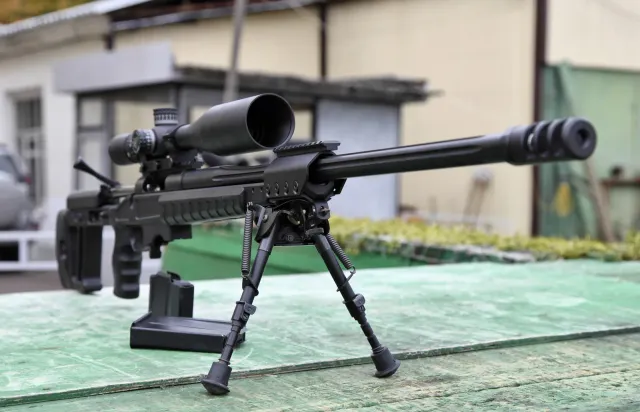
| 2 | ORSIS T-5000 | Russia | 1,500 m | 8.6 mm |
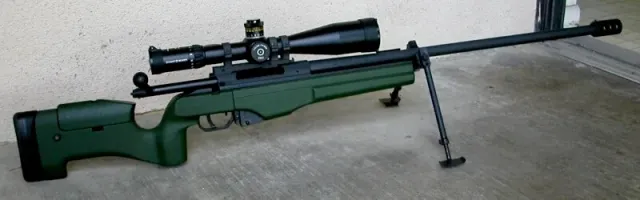
| 3 | Sako TRG-42 | Finland | 1,200 m | 8.6 mm |
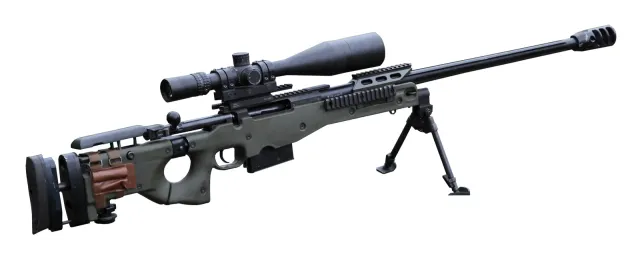
| 4 | Accuracy International AWM | United Kingdom | 1,100 m | 8.6 mm |
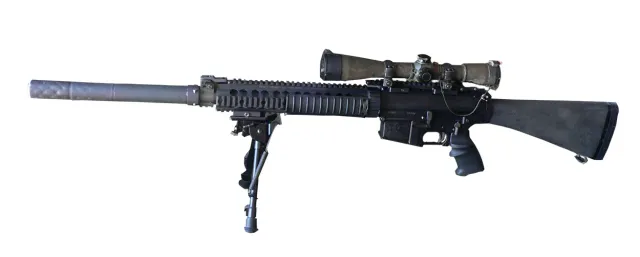
| 5 | Knight’s SR-25 | United States | 800 m | 7.62 mm |
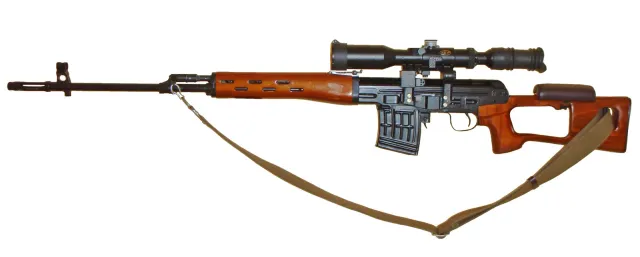
| 6 | SVD Dragunov | Russia | 800 m | 7.62 mm |
The Barrett M82 sits alone at the top with a 1,800 m effective range in 12.7 mm, better known as .50 BMG. The ORSIS T-5000, Sako TRG-42, and Accuracy International AWM cluster in the middle, all built around an 8.6 mm cartridge, ranging from 1,500 m down to 1,100 m. The Knight’s SR-25 and SVD Dragunov close out the list, tied at 800 m on 7.62 mm. Read as a single ladder, it looks like a clean hierarchy. Read by category, it’s two separate stories.
Why does the Barrett M82 outrange everything else on this list?
Mostly because of what it was built to shoot at. The M82 was designed as an anti-materiel rifle, meaning its intended targets were never primarily people, they were equipment: parked aircraft, light vehicles, radar dishes, fuel and ammunition stores, things that need to be disabled from well outside the range of return fire or a defended perimeter. Hitting that kind of target reliably at extreme distance meant building around the largest practical man-portable cartridge, the .50 BMG, a round that carries dramatically more kinetic energy downrange than anything smaller. That energy is what buys the 1,800 m figure. The tradeoff is weight and recoil, a .50 caliber rifle and its ammunition are heavy to carry and punishing to fire compared to the other guns on this list, which is a cost the anti-materiel role was built to accept.
Is the ORSIS T-5000’s 1,500 m range figure independently verified?
Not that we can confirm, and that caveat matters here specifically. The 1,500 m effective range attributed to the ORSIS T-5000 comes from Russian manufacturer disclosures, and we have not found independent testing from a Western agency or neutral ballistics lab confirming that figure under controlled conditions. That doesn’t mean it’s wrong. It means it’s a claim from the party with every incentive to publish a strong number, not a measurement a third party has replicated. The Sako TRG-42 and Accuracy International AWM, by contrast, come out of Finland and the United Kingdom respectively, with a longer public track record in NATO-adjacent precision-rifle circles and correspondingly more independent scrutiny of their published specs. Same 8.6 mm class, same general range band, different evidentiary footing.
Why do the SR-25 and Dragunov trail so far behind on range, and does that make them worse rifles?
It doesn’t, because they’re not trying to win the same contest. The Knight’s SR-25 and SVD Dragunov are both semi-automatic designated marksman rifles (DMRs), a category built around a completely different tactical requirement than the four bolt guns above them. A DMR’s job is to let one shooter embedded in an infantry squad or platoon engage targets faster and at somewhat greater range than a standard-issue service rifle allows, without slowing down to work a bolt between shots. That means staying semi-automatic, which in turn caps how far the cartridge and action can be pushed before accuracy and reliability start to suffer. Both rifles run 7.62 mm, a well-proven infantry-caliber round, and both land at 800 m, shorter than the bolt-action rifles above them, but appropriate for a rapid-engagement support role rather than a dedicated long-range interdiction mission. Shorter range here reflects a different job description, not a worse rifle.
Bolt-action or semi-automatic: which is the better sniper platform?
Neither, on its own, answers the question, because the two actions are optimized for different things. Bolt-action rifles, the Barrett M82, ORSIS T-5000, Sako TRG-42, and Accuracy International AWM among them, have fewer moving parts cycling during the shot, which generally produces tighter shot groups and more consistent first-round placement at extreme distance. That’s precisely why every rifle chasing the top of this range list is a bolt gun. Semi-automatic rifles like the SR-25 and Dragunov give up some of that outer-edge precision in exchange for faster follow-up shots, useful when a squad needs suppressive precision fire rather than a single, deliberate, mile-plus shot. Choosing between them isn’t a question of which is objectively better, it’s a question of whether the mission calls for one carefully placed shot at maximum distance or sustained accurate fire at a shorter, still-lethal range.
What this ranking actually tells you
Treat the effective-range column as a measurement of cartridge energy and design intent, not a scoreboard. The Barrett M82’s 1,800 m figure is real and well-documented for a dedicated anti-materiel platform. The ORSIS T-5000’s 1,500 m sits second, but on Russian manufacturer sourcing that hasn’t been independently confirmed by a Western testing body, worth flagging every time that number gets repeated. The Sako TRG-42 and Accuracy International AWM round out the precision bolt-gun tier on 8.6 mm with a longer independent testing record behind them. And the SR-25 and Dragunov, tied at the bottom on range, aren’t underperforming, they’re built for a squad-support role where range was never the priority in the first place. Six rifles, one column of numbers, and at least two genuinely different reasons those numbers look the way they do.
Compare, filter, or find the right rifle for your use case
Run any two of these platforms side by side in the comparison tool, browse the full rifle class in the rifle types directory, or work through mission requirements in the Advisor if you’re trying to match a rifle to a role rather than a leaderboard position. More breakdowns like this one are collected on the WeaponSpecs articles page.
Systems in this comparison
Every system covered above, with its photo and, where available, a video. Tap a card to open the full spec sheet.
Compare these side by side →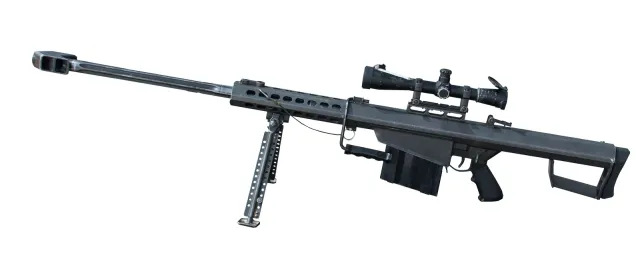
Frequently asked questions
Does a longer effective range always mean a better sniper rifle? +
No. Effective range is one variable tied to caliber, barrel length, and cartridge energy, not a standalone verdict on quality. A rifle built for anti-materiel work at 1,800 m and a rifle built for a designated marksman covering a squad at 800 m are solving different problems. Ranking them on a single meters figure flattens a distinction that matters more than the number itself.
Why does caliber affect effective range so directly? +
Bigger, heavier bullets carry more kinetic energy downrange and resist wind drift and velocity decay better than smaller rounds. The .50 BMG round fired by the Barrett M82 weighs roughly ten times what a 7.62 mm round weighs, which is the main reason its effective range roughly doubles that of the 7.62 mm rifles on this list. The 8.6 mm rounds used by the ORSIS T-5000, Sako TRG-42, and AI AWM sit in between, heavier than 7.62 mm, lighter than .50 BMG, and their ranges land in between too.
What's the real difference between an anti-materiel rifle and an anti-personnel sniper rifle? +
An anti-materiel rifle, the Barrett M82's original design purpose, is built to disable equipment: parked aircraft, light vehicles, radar arrays, fuel depots, from standoff distance using a large-caliber round. An anti-personnel sniper rifle is built around a smaller, still-precise cartridge optimized for hitting a human-sized target, often at somewhat shorter range, with less weight and recoil for the shooter to manage. The M82 can do both jobs, but its range and caliber were driven by the materiel-defeat requirement first.
Why do 7.62 mm designated marksman rifles like the SR-25 and Dragunov have shorter range than .50 caliber rifles? +
Because they aren't trying to match .50 caliber range. The Knight's SR-25 and SVD Dragunov are semi-automatic designated marksman rifles, built to let one shooter in a squad engage targets faster than a bolt gun allows, at ranges beyond a standard rifleman's zero but well short of dedicated long-range precision work. Their 800 m effective range reflects the 7.62 mm cartridge and a rapid-engagement role, not a shortfall against the bolt-action rifles above them on this list.
Is a bolt-action rifle inherently more accurate than a semi-automatic one? +
At extreme range, generally yes, a bolt-action design has fewer moving parts during the firing cycle, which tends to produce tighter shot groups and more consistent first-round accuracy, which is why the Barrett M82, ORSIS T-5000, Sako TRG-42, and Accuracy International AWM are all bolt guns. Semi-automatic rifles like the SR-25 and Dragunov trade some of that ultimate precision for faster follow-up shots, which is the point of a designated marksman role rather than a design flaw.
Related reading