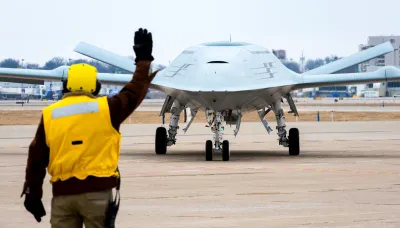
Australia and Fiji sign mutual-defense pact to counter China
Landmark 'Ocean of Peace' treaty deepens Fiji-Australia security ties with an economic package worth over AUD $1 billion and an open-membership clause for other Pacific states.
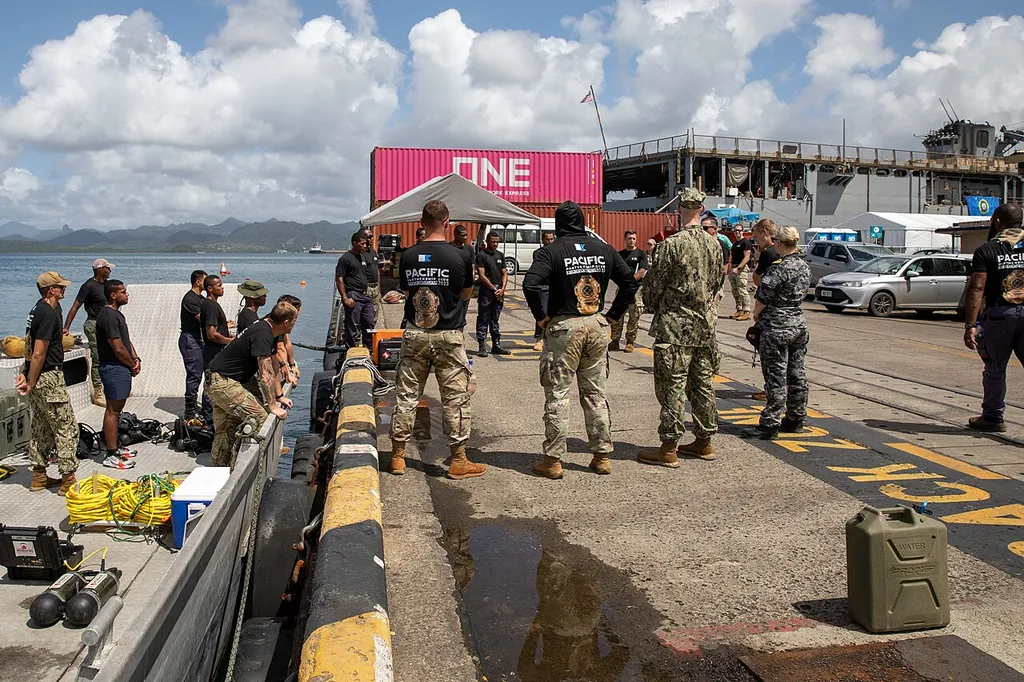
U.S. Navy photo, Pacific Partnership 2023 with the Republic of Fiji Military Forces, via Wikimedia Commons, public domain.
Australian Prime Minister Anthony Albanese and Fijian Prime Minister Sitiveni Rabuka signed a bilateral mutual-defense treaty in Suva on July 6, a framework reported under the name “Ocean of Peace,” according to Euronews. The pact is paired with an accompanying economic framework that The Canberra Times reports includes more than AUD $1 billion in Australian investment, and it carries an open-membership clause allowing other Pacific nations, notably Papua New Guinea and Tonga, to join later, per The Japan Times.
The signing lands in the same week China conducted a submarine-launched ballistic missile test in the Pacific, a coincidence of timing rather than a directly linked event, but one that underscores how much of this week’s Pacific security news has centered on the same broad contest for influence and access across the region.
Why is Fiji the partner Australia chose to formalize with?
Fiji sits astride key South Pacific sea lanes and has long functioned as a diplomatic and logistical hub for the wider Pacific Islands region, making it a natural anchor point for any Australian-led regional security architecture rather than simply one bilateral relationship among many. Canberra Times’ framing, “meet a common danger,” signals the treaty language itself invokes a shared-threat rationale rather than routine defense cooperation, according to The Canberra Times, language that reads as a deliberate escalation from prior, lower-key Australia-Fiji defense arrangements toward something closer to a formal alliance commitment.
What triggered Australia’s push for a formal pact now?
The clearest catalyst is China’s April 2022 security agreement with the Solomon Islands, which opened the door to Chinese security personnel and warship visits in a nation roughly 2,000 kilometers from Australia’s northeast coast. That agreement alarmed both Canberra and Washington at the time, less because of any single immediate military consequence than because of what it represented: a foothold for Chinese security presence in a part of the Pacific Australia had long treated as its own strategic backyard. Since then, Australian Pacific policy has consistently paired direct outreach to individual island nations with development financing, treating diplomatic and economic engagement as inseparable tools rather than separate tracks, a pattern this Fiji pact continues at a larger scale than prior efforts.
What does the economic package actually involve?
The reported AUD $1 billion-plus investment framework functions as the pact’s second half, offering Fiji a concrete development dividend rather than asking it to accept a security commitment on its own terms. That combination directly mirrors the logic behind China’s own regional playbook, infrastructure and development financing extended alongside political and security engagement, and represents Australia competing on comparable terms rather than relying on historical ties or geographic proximity alone to hold the relationship. Whether the specific $1 billion figure refers to new commitments or a repackaging of existing aid and investment flows is not fully clear from the available reporting, and is presented here as reported by The Canberra Times rather than independently itemized.
Why does the open-membership clause matter more than the bilateral deal itself?
A clause allowing Papua New Guinea and Tonga to join later turns what could have been read as a narrow Australia-Fiji arrangement into the potential foundation of a wider regional security bloc. Papua New Guinea, the largest Pacific Island nation by population and already host to a significant Australian and U.S. security relationship, would be a particularly consequential addition if it eventually joins. Tonga, further south and east, would extend the framework’s geographic reach. Building that expansion option into the treaty from the outset, rather than treating Fiji as a one-off deal, suggests Australia is deliberately trying to construct a durable multilateral structure now, while the political will and financing are available, rather than negotiating each additional country from scratch later.
What to watch next
The most useful signal to track is not this signing itself but whether Papua New Guinea or Tonga move to formally join within the next several months, which would confirm the open-membership clause is a real mechanism rather than aspirational treaty language. A second signal worth watching is how China’s government responds diplomatically, and whether it accelerates its own outreach to Pacific nations not yet aligned with either bloc, a pattern that has repeated after prior Australian or U.S. security initiatives in the region.
By the numbers
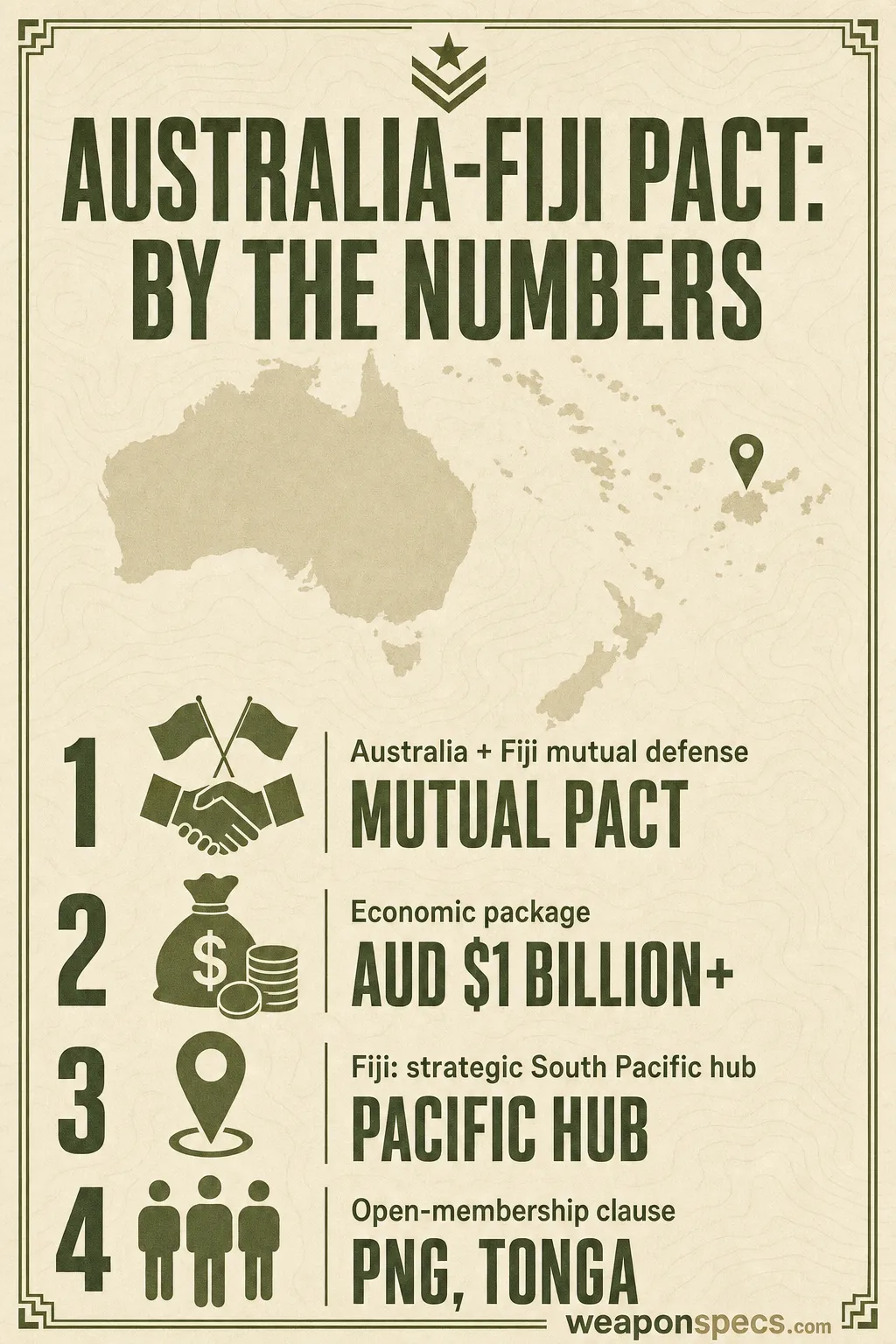
Infographic: WeaponSpecs News Desk
Sources
- Australia, Fiji seal 'Ocean of Peace' defense alliance — The Japan Times, Jul 6, 2026
- Australia and Fiji seal mutual defence pact in push to counter China in Pacific — Euronews, Jul 6, 2026
- 'Meet a common danger': Australia, Fiji seal new alliance — The Canberra Times, Jul 6, 2026
Frequently asked questions
Why is this agreement significant? +
It formalizes a mutual-defense relationship between Australia and Fiji, a strategically located South Pacific hub, at a moment when China is actively courting security partnerships across the Pacific Islands. It pairs the security commitment with a substantial economic investment package, a dual-track approach Australia has increasingly leaned on in the region.
How does this relate to China's 2022 pact with the Solomon Islands? +
The 2022 China-Solomon Islands security agreement, which opened the door to Chinese security personnel and naval visits, alarmed Canberra and Washington and is widely read as the direct catalyst for Australia's push to lock in its own formal security partnerships with other Pacific nations, Fiji foremost among them.
What does the economic package involve? +
Australian reporting describes an accompanying economic framework with more than AUD $1 billion in Australian investment, intended to pair the security commitment with tangible development benefits for Fiji, a combination meant to compete directly with Chinese infrastructure financing in the region.
Can other Pacific nations join the agreement? +
Yes. The framework includes an open-membership clause allowing other Pacific nations to join, with Papua New Guinea and Tonga specifically named as likely candidates, positioning the pact as the foundation of a broader regional security architecture rather than a strictly bilateral deal.
More news