Pentagon weapons delays average 12 years, GAO warns
Watchdog finds immature tech, supply chains and workforce cuts strain 104 major programs worth $2.4 trillion; MQ-25 and hypersonics both hit.
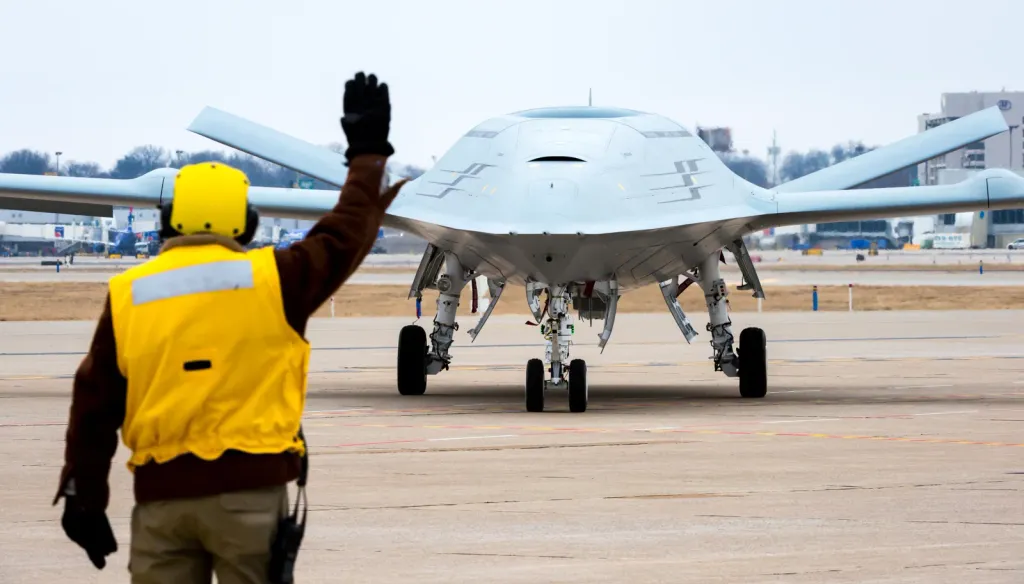
Eric Shindelbower, U.S. Navy, via Wikimedia Commons, Public Domain (shown for identification). Shows the Boeing MQ-25 Stingray, one of the delayed programs named in the GAO report.
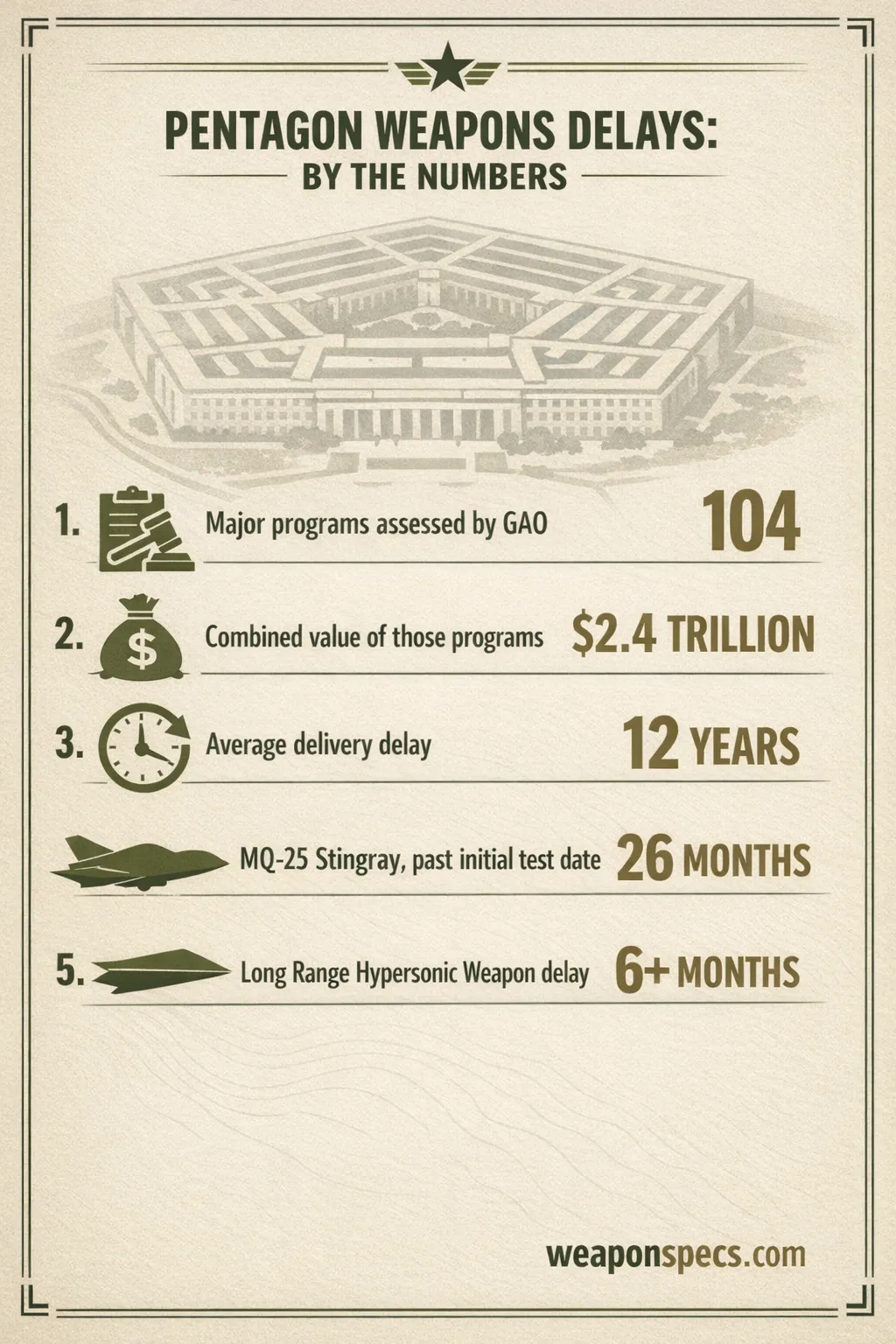
The Pentagon’s costliest weapons programs now take an average of more than 12 years to deliver a capability to troops, according to a Government Accountability Office report covering 104 major programs worth a combined $2.4 trillion in planned investment, per Breaking Defense. The watchdog’s annual weapons-assessment report, released in early July and drawing wide coverage on July 6, singles out the Navy’s MQ-25 Stingray unmanned tanker, the Army and Air Force’s Long Range Hypersonic Weapon, and the Space Force’s Next-Gen OPIR-GEO missile-warning satellite as specific programs running behind their own baselines, according to Army Times.
A 12-year average delivery time is not a new problem restated, it is a worsening one. GAO’s weapons assessments over the past decade have repeatedly tracked schedule growth across the Pentagon’s acquisition portfolio, but this year’s finding puts a specific, citable number on how far the typical program now runs past its original timeline, at a moment when the department is also under pressure to field capability quickly against fast-moving threats like hypersonic weapons and drone warfare. The gap between “we need this fast” and “our own average program takes over a decade” is the tension this report is really describing.
Which programs did GAO name, and by how much are they delayed?
The MQ-25 Stingray, a carrier-based unmanned aerial refueling tanker built to extend the reach of Navy carrier air wings, is running approximately 2.5 years behind its original initial-operating-capability target and 26 months past its planned initial operational test and evaluation date, per GAO’s assessment. WeaponSpecs’ own system database lists the MQ-25 as a carrier-based unmanned tanker with roughly 926 kilometers of range, a relatively modest technical profile for a program that has nonetheless struggled to hold its schedule, which is itself part of GAO’s broader point: even programs that are not attempting an especially exotic technical leap are running years late.
The Long Range Hypersonic Weapon, or LRHW, a joint Army-Air Force hypersonic glide-vehicle program, is delayed at least 6 months due to inconsistencies in meeting production standards, per Breaking Defense. That program has drawn particular attention because it represents the U.S. military’s first fielded hypersonic weapon, and any slip in it carries outsized visibility given how much of the recent defense-policy conversation has centered on closing a perceived hypersonic gap with China and Russia. The Next-Gen OPIR-GEO missile-warning satellite, meanwhile, is roughly 4 months behind schedule, with launch not expected before October 2026, according to Army Times.
What is actually causing the delays?
GAO attributes the slippage to three compounding drivers rather than a single root cause. Supply-chain disruption is straining suppliers who are simultaneously being asked to support 2026 replenishment demand, meaning the same limited manufacturing base is being pulled in multiple directions at once. Immature technology entering fast-track acquisition pipelines is a second driver: GAO found that 18 of the 40 programs that entered the Middle Tier of Acquisition, or MTA, pathway between 2018 and 2025 did so with technologies that were not yet mature, according to Breaking Defense. The MTA pathway exists specifically to favor speed-to-field over the traditional, slower maturation process, which makes this finding somewhat self-undermining: a program built for speed that enters with unready technology tends to shed that speed advantage later, once integration problems surface downstream.
The third driver is workforce capacity. Staffing cuts in 2025, including reductions affecting the Director of Operational Test and Evaluation’s office, reduced the department’s independent oversight bandwidth precisely as the number and complexity of programs needing that oversight kept growing, per Army Times. Fewer test-and-evaluation staff generally means problems get caught later in a program’s life, when they are more expensive and time-consuming to fix, rather than earlier when a course correction is cheaper.
Why does the Middle Tier of Acquisition pathway keep coming up?
The MTA pathway, created to let the Pentagon field new capability in roughly five years instead of the traditional decade-plus acquisition cycle, is meant to be used for technology that is already mature enough to move quickly. GAO’s finding, that nearly half of MTA programs since 2018 entered with technology that was not actually ready, describes a pathway being used for a purpose it was not designed for: using MTA’s speed to compensate for schedule pressure rather than reserving it for genuinely mature systems. That distinction matters because it reframes part of the “12 year average” headline: some of that lag is not a failure of the traditional slow process at all, it is fast-track programs quietly reverting to slow-process timelines once their immature technology problems surface mid-program.
What does GAO recommend?
GAO’s central recommendation is to separate technology maturation from system integration: mature a critical technology on its own track first, then fold it into a fielded program, rather than developing both simultaneously under a compressed MTA schedule. That is a structural fix aimed at the acquisition process itself rather than any single program, which is consistent with how GAO has framed its recurring weapons assessments in past years: less about blaming individual program managers and more about flagging a systemic pattern that keeps repeating across otherwise unrelated programs.
By the numbers
Infographic: WeaponSpecs News Desk
Sources
- Pentagon Continues To Struggle With Key Weapons Development Timelines: GAO — Breaking Defense, Jul 6, 2026
- Pentagon's top new weapons programs are 12 years behind schedule, watchdog says — Army Times, Jul 6, 2026
Systems mentioned
Every system named in this story, with its photo and, where available, a video. Tap a card to open the full spec sheet.
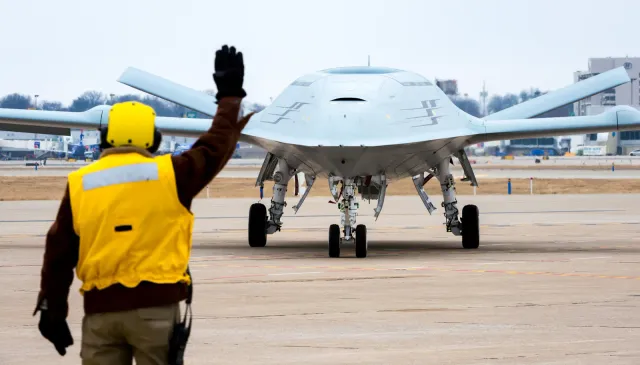
UAV / drone
MQ-25 StingrayFrequently asked questions
Which weapons programs were named as most delayed? +
The Navy's MQ-25 Stingray unmanned tanker is running roughly 2.5 years behind its original initial-operating-capability target and 26 months past its initial operational test date. The Army and Air Force's Long Range Hypersonic Weapon battery is delayed at least 6 months by production-standard inconsistencies, and the Next-Gen OPIR-GEO missile-warning satellite is roughly 4 months late, with launch not expected before October 2026.
What is causing the delays? +
GAO points to three main drivers: supply-chain disruption straining suppliers already stretched by 2026 replenishment demand, immature technology entering fast-track acquisition pipelines before it is ready, and workforce shortages after 2025 staffing cuts that reduced independent test and oversight capacity.
How does the Middle Tier of Acquisition pathway contribute to the problem? +
The Middle Tier of Acquisition, or MTA, pathway is designed to field capability faster by favoring speed over fully mature technology. GAO found that 18 of 40 programs entered the MTA pathway between 2018 and 2025 with immature technologies, which tends to shift cost and schedule risk later into the program rather than eliminating it.
What does GAO recommend? +
GAO's core recommendation is to mature critical technologies separately, before folding them into a fast-track program, rather than developing the technology and the fielded system simultaneously under schedule pressure.
More news