Nuclear vs AIP Submarines: Which Should You Buy?
Nuclear vs AIP submarines: nuclear buys unlimited range at huge cost; diesel-electric AIP buys quiet littoral stealth for a fraction of the price.
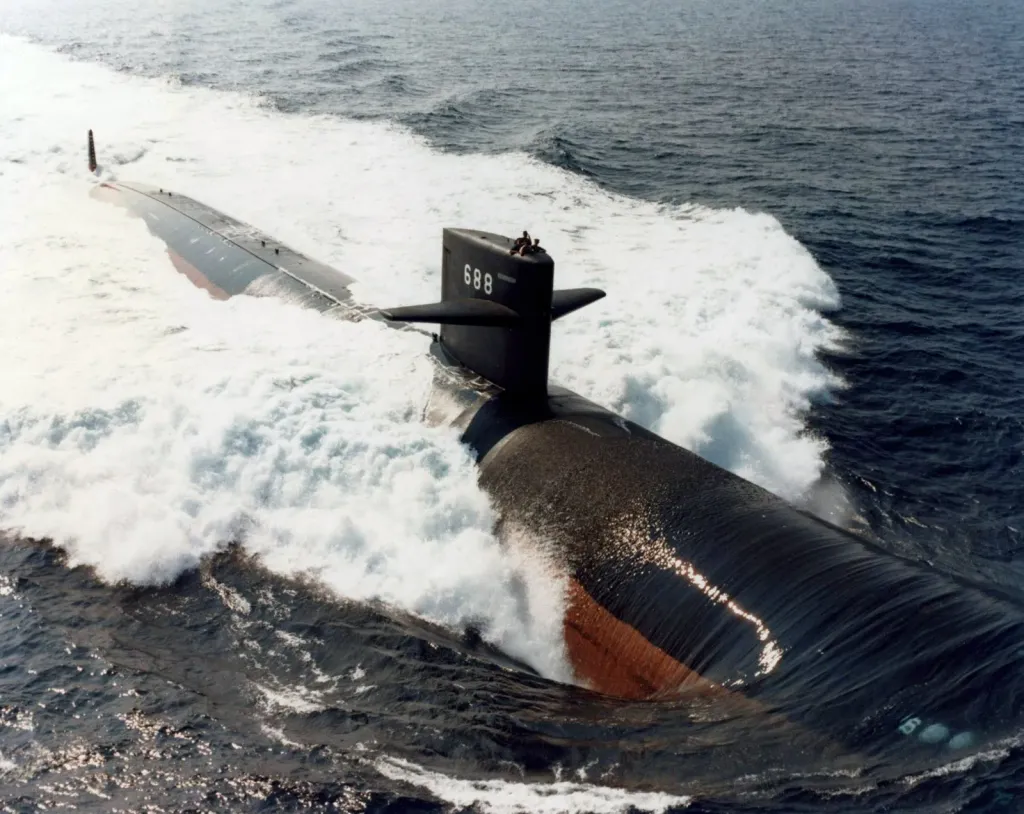
Via Wikipedia, Los Angeles-class submarine (shown for identification)
The real decision isn’t “which submarine is better”, it’s “what does your navy actually need to do.” A nuclear-powered attack submarine (SSN) gives you unlimited submerged range and endurance capped only by how much food the crew can carry, at a cost and technical burden only a handful of nations have ever cleared. A modern diesel-electric boat with air-independent propulsion (SSK/AIP) trades that unlimited range for something else entirely: exceptional quiet at low speed, a fraction of the price, and an export path open to dozens of navies that will never operate a reactor at sea. Neither is the objectively “better” submarine, they’re different tools built for different waters and different budgets, and confusing the two is how procurement programs go sideways.
What nuclear propulsion actually buys you
A naval reactor doesn’t need air, doesn’t need to surface, and doesn’t need refueling for the life of the core in most modern designs. That’s the entire pitch: an SSN can cross an ocean submerged, loiter on station for months, and sprint at high speed indefinitely, limited by crew endurance and provisions rather than the propulsion plant. That’s why blue-water navies with global power-projection missions, trailing another nation’s ballistic-missile submarines, escorting carrier strike groups across oceans, or holding a forward station thousands of miles from home for months, build and operate SSNs despite the cost.
The price of that unlimited range is significant. Reactor technology, its supporting supply chain, specialized shipyards, and the decades of sustained budget commitment required to build and crew these boats put SSNs out of reach for all but a short list of nations: the United States, Russia, the United Kingdom, France, China, and India, with a few others pursuing the capability. Nonproliferation frameworks also restrict the technology’s spread, the AUKUS submarine-technology-sharing arrangement between the U.S., UK, and Australia is a rare and heavily negotiated exception, not a template other nations can casually copy.
What AIP buys you instead
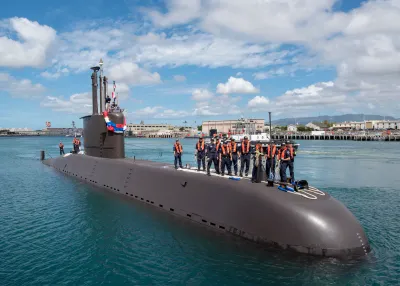
Air-independent propulsion doesn’t try to match a reactor’s unlimited endurance, it solves a narrower problem. Conventional diesel-electric submarines have always had to surface or snorkel every day or two to recharge batteries, the moment they’re most vulnerable to detection. AIP systems, most commonly Stirling engines (Sweden, Japan) or proton-exchange-membrane fuel cells (Germany’s Type 214 family), let the boat generate power submerged without air from outside, extending that window from a couple of days to one to three weeks at low, quiet speeds.
That’s transformative for a specific mission: sitting quietly in a strait, a coastal approach, or an archipelago, waiting. AIP boats aren’t built to cross oceans at speed; they’re built to disappear into shallow, acoustically cluttered littoral water and stay there. For a navy defending a coastline, choke point, or exclusive economic zone rather than projecting power globally, that’s exactly the capability that matters, and it costs a small fraction of what an SSN program does.
The numbers, side by side
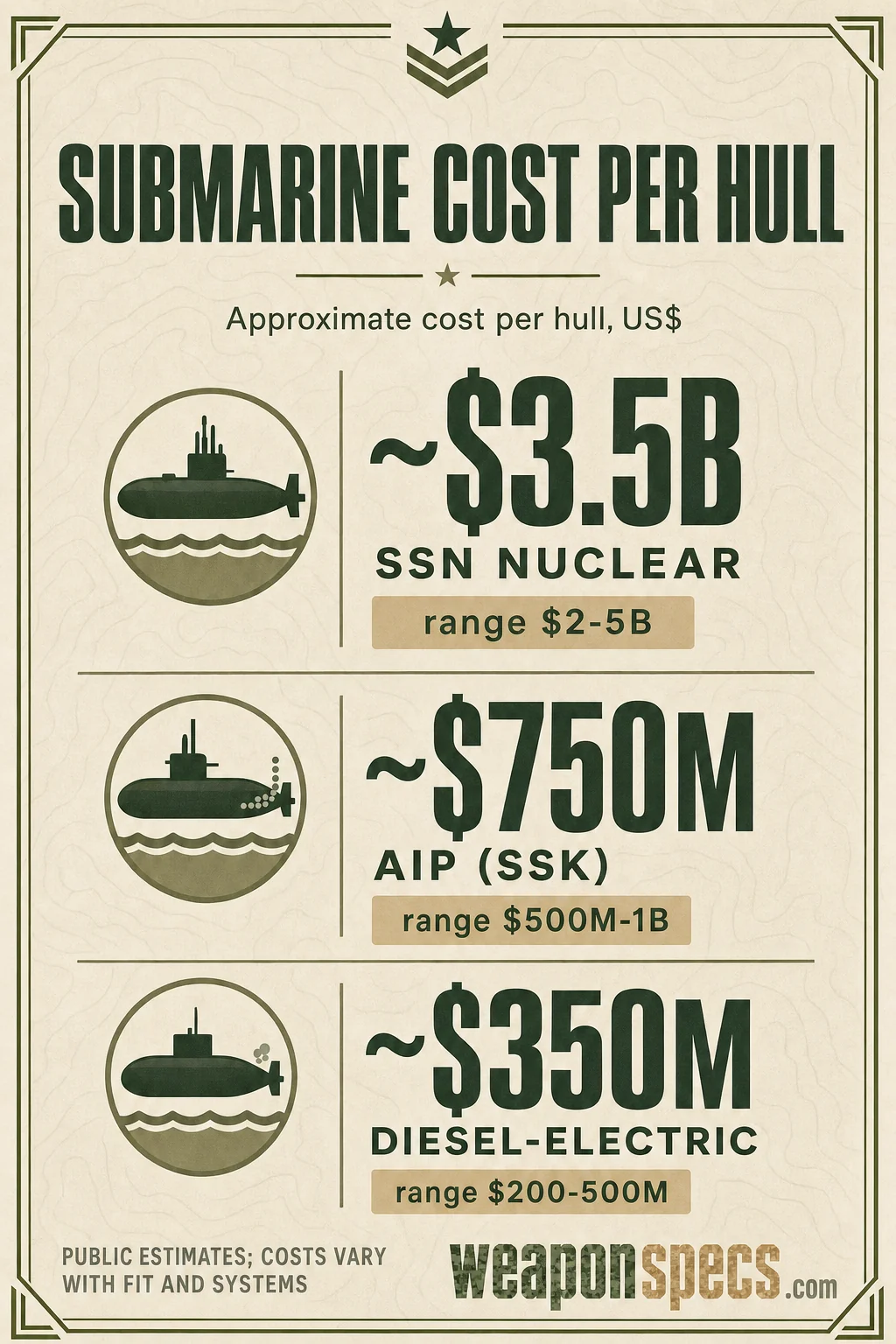
| Type | Submerged endurance | Approx. cost per hull | Operators (public/reported) | Best-use mission |
|---|---|---|---|---|
| Nuclear attack submarine (SSN) | Weeks to months (reactor-limited only by crew supplies) | ~$2-5 billion | US, UK, France, Russia, China, India | Blue-water, ocean-crossing, sustained forward presence |
| Diesel-electric with AIP (SSK/AIP) | ~1-3 weeks at low speed on AIP, days on battery alone | ~$500 million-$1 billion | Germany, Sweden, Japan, South Korea, several export customers | Littoral defense, chokepoint denial, coastal ISR |
| Conventional diesel-electric (no AIP) | A few days before snorkeling required | ~$200-500 million | Widely operated, dozens of navies | Coastal patrol on constrained budgets |
Treat every figure here as a public estimate drawn from open reporting and manufacturer disclosures rather than an audited program number, submarine costs vary enormously with weapons fit, combat systems, and whether the figure includes the shore infrastructure and training pipeline that come with the boat.
Acoustic stealth: it’s not as simple as “nuclear is louder”
The popular shorthand, “diesel boats are quieter”, is true but incomplete. A modern AIP submarine running on battery or Stirling power at a few knots can be extraordinarily quiet, because it has no reactor coolant pumps, no steam turbines, and none of the mechanical noise sources a nuclear plant carries even at idle. That’s why AIP boats have reportedly “killed” carriers and escorts in exercises against much larger navies, in the right acoustic conditions, at low speed, in shallow water, they’re genuinely hard to find.
But that quiet comes with a speed ceiling. Push an AIP boat to high submerged speed and it has to shift to noisier diesel-electric power on battery, burning down its limited reserve fast. An SSN, by contrast, can run fast and relatively quiet simultaneously thanks to decades of investment in reactor plant silencing, and it never faces the AIP boat’s hard endurance wall. The honest comparison isn’t “which is quieter”, it’s “quiet at what speed, for how long, in what water.” AIP wins the littoral, low-speed, short-duration case. SSNs win everywhere endurance, speed, and sustained operations matter more than absolute silence at a crawl.
Cost and proliferation: the real gatekeeper
Cost is the more decisive variable for most navies, and it isn’t just the hull price. An SSN program requires a sovereign or allied reactor-fuel supply chain, specialized construction and refueling facilities, a much larger and more specialized crew training pipeline, and decommissioning plans that account for handling spent nuclear fuel decades later. That total lifecycle burden is why so few nations attempt it, and why those that do treat it as a multi-decade national commitment rather than a single procurement line.
AIP submarines carry none of that baggage. They’re built in conventional shipyards, use existing diesel-electric supply chains, and are explicitly designed for export, Germany’s Type 214 family, South Korea’s KSS-III, and Sweden’s A26 have all been sold or offered to allied and partner navies without the nonproliferation friction that gates reactor technology. If your navy’s requirement is credible coastal deterrence rather than global reach, AIP is not a compromise pick, it’s the correctly sized tool, and it’s one you can actually buy.
Who should buy what
A nation defending long coastlines, archipelagic waters, or critical chokepoints, the Baltic, the Turkish Straits, the South China Sea’s shallower shelves, should buy AIP. It’s cheaper, exportable, easier to crew and sustain, and tactically suited to exactly the water it will fight in. A blue-water navy that needs to shadow adversary submarines across ocean basins, sustain a forward presence for months, or keep pace with a carrier strike group has no real AIP substitute, that mission belongs to SSNs, and the cost is the price of admission for operating at that scale.
The mistake to avoid is buying capability you can’t use. An SSN sitting in littoral, acoustically shallow water doesn’t get to exploit its endurance advantage and pays for speed and sensor overhead it doesn’t need there. An AIP boat asked to cross an ocean and hold station for months will run out of the very endurance that makes it valuable in its intended role. Match the boat to the water and the mission first, the budget conversation follows from that, not the other way around.
The bottom line
Nuclear and AIP submarines aren’t rungs on the same ladder, they’re answers to different questions. SSNs answer “how do we operate anywhere in the world’s oceans indefinitely,” a mission only a handful of nations can fund and only a shorter list can build. AIP answers “how do we deny or dominate our own coastal waters affordably and quietly,” a mission most navies actually have. Buyers should resist the instinct to chase the more prestigious platform and instead work backward from the water they need to control.
Compare the underlying platforms directly with the Astute-class vs. A26 Blekinge breakdown on WeaponSpecs, browse the full submarine class to see how other SSNs and SSKs stack up on cost and endurance, or run your own mission profile through the Advisor tool to see which type actually fits your requirement. For more procurement breakdowns like this one, check the WeaponSpecs articles.
Systems in this comparison
Every system covered above, with its photo and, where available, a video. Tap a card to open the full spec sheet.
Compare these side by side →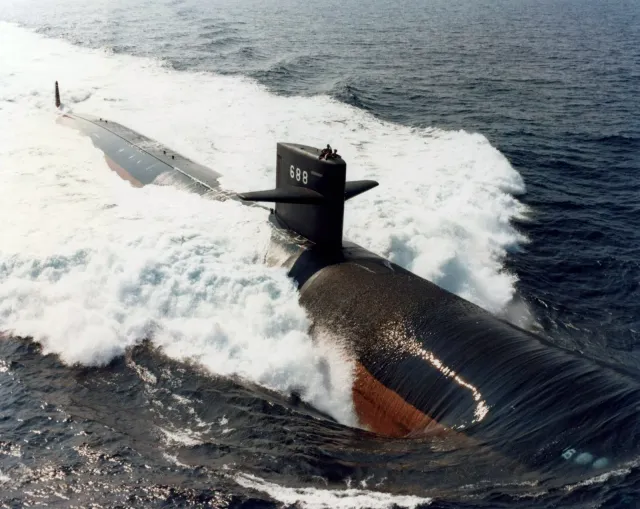
Submarine
Columbia-class Submarine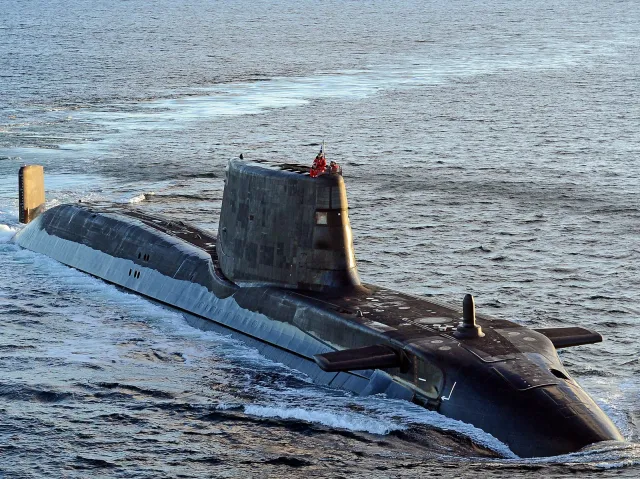
Submarine
Astute classSubmarine
A26 Blekinge-class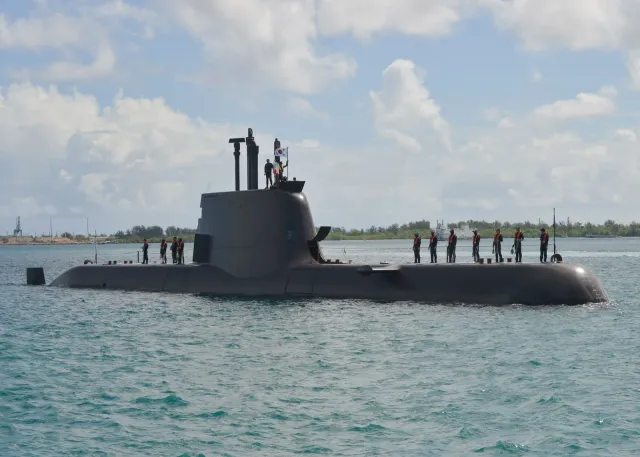
Frequently asked questions
What is the difference between nuclear and AIP submarines? +
Nuclear submarines (SSNs) use a reactor for near-unlimited submerged range and endurance limited only by crew food. AIP submarines are diesel-electric boats with an auxiliary system that lets them stay submerged for one to three weeks instead of days, at a fraction of the cost and complexity.
Are diesel-electric submarines quieter than nuclear? +
In short bursts on battery or AIP power at low speed, modern SSKs can be exceptionally quiet, often quieter than an SSN, because they lack a reactor's pumps and cooling loops. Nuclear boats trade some of that stealth for unlimited high-speed endurance.
How much does a submarine cost? +
Publicly reported figures suggest modern SSNs run roughly $2-5 billion per hull depending on class and country, while AIP-equipped diesel-electric submarines typically run $500 million to $1 billion. Treat all figures as public estimates, most program costs are partly classified.
What is air-independent propulsion (AIP)? +
AIP is a supplementary propulsion system, commonly Stirling engines or fuel cells, that lets a diesel-electric submarine generate power without surfacing or snorkeling, extending submerged endurance from a few days to one to three weeks at low speed.
Why do few countries operate nuclear submarines? +
Building and running an SSN requires naval reactor technology, enrichment or supply agreements, specialized shipyards, and decades of sustained budget commitment. Only a handful of nations have ever cleared that bar, and nonproliferation agreements restrict who can acquire the technology.
Related reading