Documents
 Turkey
 Baykar
Bayraktar Akinci
A twin-turboprop, high-altitude long-endurance combat drone that scales up Baykar's Bayraktar family into a heavier strike platform capable of carrying air-to-air and precision-guided munitions. It gives Turkey an indigenous alternative to larger Western and Chinese strike UAVs.
In service since 2021 · 5 operator countries
Compiled from public sources ·primary reference ↗ ·last verified 2026-07-05
444
km/h
6,000
km range
12,192
m ceiling
1,500
kg payload
💲 ≈ $30,000,000, Publicly cited export system unit price estimate
Procurement snapshot
Availability & export
Türkiye export-licensed
SSB-administered; growing export programme, some Western sub-component dependencies.
Channel: Direct commercial / G2G
Fielded & proven
Established · 5 operators
In service since 2021. Status: active · ~60 built.
Lifecycle cost (est.)
$75M – $105M
Acquisition is only ~30% of lifecycle cost, operating & support dominate over ~20 yrs. Rough 2.5–3.5× the unit price.
Interoperability
No standardised NATO calibre / datalink detected in public specs.
Derived guidance from public data, export regime by country of origin, lifecycle from the GAO ~30% acquisition rule. Verify eligibility, pricing and offsets with the manufacturer and your acquisition authority.
Compatible munitions & weapons
Publicly reported weapons the Bayraktar Akinci can carry. Linked items have a full spec page.

Full specifications
Performance
Speed, range, altitude and engagement capability.
- Max speed
Maximum level speed. For aircraft this is at optimal altitude; for ground vehicles, top road speed. Higher means faster response and better kinematic performance.
- 444 km/h Stronger than 81% of UAVs
- Cruise speed
Sustained economical speed. Determines transit time to station.
- 278 km/h Stronger than 87% of UAVs
- Range
Maximum distance: ferry range for aircraft, operational range for vehicles, maximum engagement distance for missiles. Higher means more standoff or persistence.
- 6,000 km Top 10% of UAVs
- Service ceiling
Maximum operating altitude. Higher gives energy advantage and sensor horizon.
- 12,192 m Stronger than 81% of UAVs
- Endurance
Time on station. Critical for UAVs and patrol platforms, higher means longer persistent coverage.
- 24 h Stronger than 68% of UAVs
Firepower
Armament, payload and guidance.
- Hardpoints
External stations for weapons and pods. More means bigger and more flexible loadouts.
- 6 Stronger than 70% of UAVs
- Weapons payload
Maximum ordnance weight the platform can carry. Higher means more strike capacity per sortie.
- 1,500 kg Stronger than 79% of UAVs
Physical
Dimensions, weight and crew.
- Length
Overall length including gun/probe where applicable.
- 12.3 m
- Wingspan
Wingtip-to-wingtip span.
- 20 m
- Height
Overall height. Lower profile is harder to spot and hit for ground vehicles.
- 4.1 m
- Empty weight
Weight without fuel, ammunition or crew.
- 3,300 kg
- Combat weight
Fully loaded weight. Lighter eases transport and bridging limits; heavier often means more armor.
- 6,000 kg
- Crew
Personnel required to operate. Fewer reduces exposure; autoloaders trade a loader for mechanical complexity.
- 0
Propulsion
Engine, power and fuel.
- Engine
Powerplant model and type.
- 2 x turboprop (450 / 750 / 850 hp variants)
- Engines
Number of engines. Twin-engine gives redundancy at higher cost.
- 2
- Propulsion type
Turbofan, turboshaft, diesel, gas turbine, solid-fuel rocket, ramjet…
- Twin turboprop, tractor propeller
Sensors & avionics
Radar, sensor suite and datalinks.
- Sensors
IRST, EO/IR turrets, laser designators, sniper pods, thermal sights.
- CATS electro-optical/infrared/laser designator turret, AESA radar (optional)
- Datalink
Network connectivity: Link 16, MADL, national datalinks. Enables cooperative engagement.
- LOS datalink, SATCOM
Program
Cost, production scale and operators.
- Unit cost
Approximate flyaway/unit cost where public. Defense pricing varies hugely by contract, offsets and configuration. Lower is cheaper.
- $30,000,000 Stronger than 21% of UAVs
- Units built
Total production run. Higher means proven manufacturing, mature logistics and spares availability.
- 60 Stronger than 24% of UAVs
- Operator countries
Number of countries operating the system. More operators means broader support ecosystem.
- 5 Stronger than 66% of UAVs
Specifications compiled from public Baykar and reference sources ↗. Published defense figures are approximations, treat comparisons as directional. Last verified 2026-07-05.
Compare with rivals
See how it stacks up
 General Atomics Aeronautical Systems MQ-9A Reaper
 Frequently asked questions
What is the top speed of the Baykar Bayraktar Akinci? +
The Baykar Bayraktar Akinci has a maximum speed of 444 km/h.
What is the range of the Baykar Bayraktar Akinci? +
The Baykar Bayraktar Akinci has a maximum range of 6,000 km.
What is the weapons payload of the Baykar Bayraktar Akinci? +
The Baykar Bayraktar Akinci can carry up to 1,500 kg of weapons payload.
How much does the Baykar Bayraktar Akinci weigh? +
The Baykar Bayraktar Akinci has a combat weight of 6,000 kg.
How many crew does the Baykar Bayraktar Akinci require? +
The Baykar Bayraktar Akinci requires a crew of 0.
What engine does the Baykar Bayraktar Akinci use? +
The Baykar Bayraktar Akinci is powered by the 2 x turboprop (450 / 750 / 850 hp variants).
What is the Baykar Bayraktar Akinci used for? +
The Baykar Bayraktar Akinci is a uav / drone typically used for isr, close air support, deep strike.
How many countries operate the Baykar Bayraktar Akinci? +
The Baykar Bayraktar Akinci is operated by 5 countries.
How much does the Baykar Bayraktar Akinci cost? +
The Baykar Bayraktar Akinci has an approximate unit cost of 30,000,000 USD. Defense pricing varies by contract, offsets and configuration, treat this as directional.
Similar systems
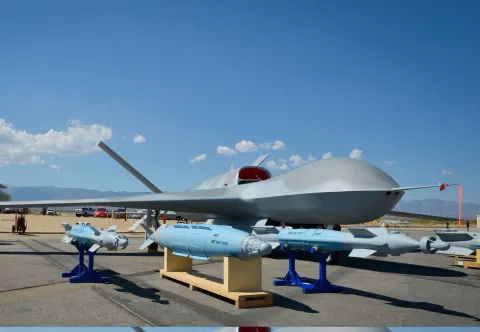
General Atomics Aeronautical Systems
Avenger (Predator C)
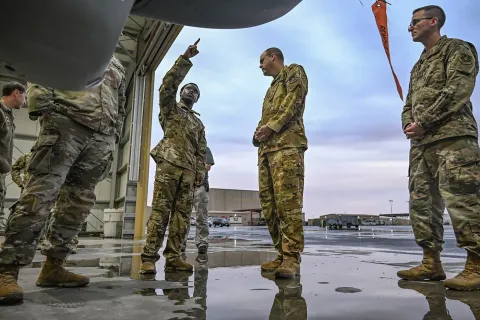
General Atomics Aeronautical Systems
MQ-9A Reaper
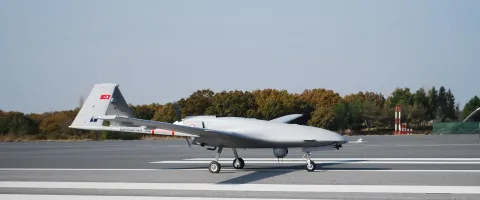
Baykar
Bayraktar TB2S
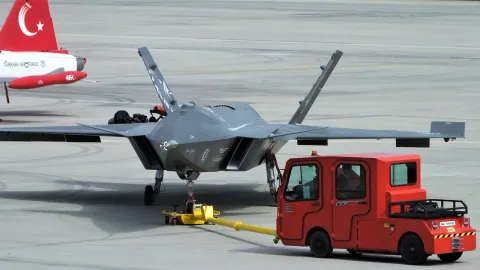
Baykar