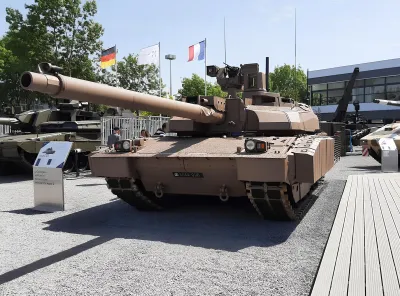
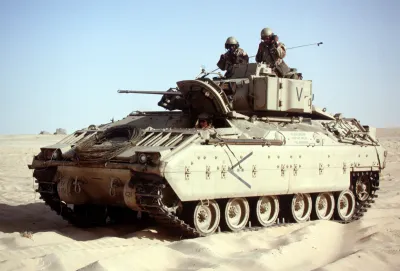
M1A2 Abrams vs T-90M vs Type 99A: Tank Power-to-Weight
The M1A2 SEP v3 Abrams is the heaviest of the three at 66.8 tonnes, giving it the lowest power-to-weight ratio despite the most powerful engine.
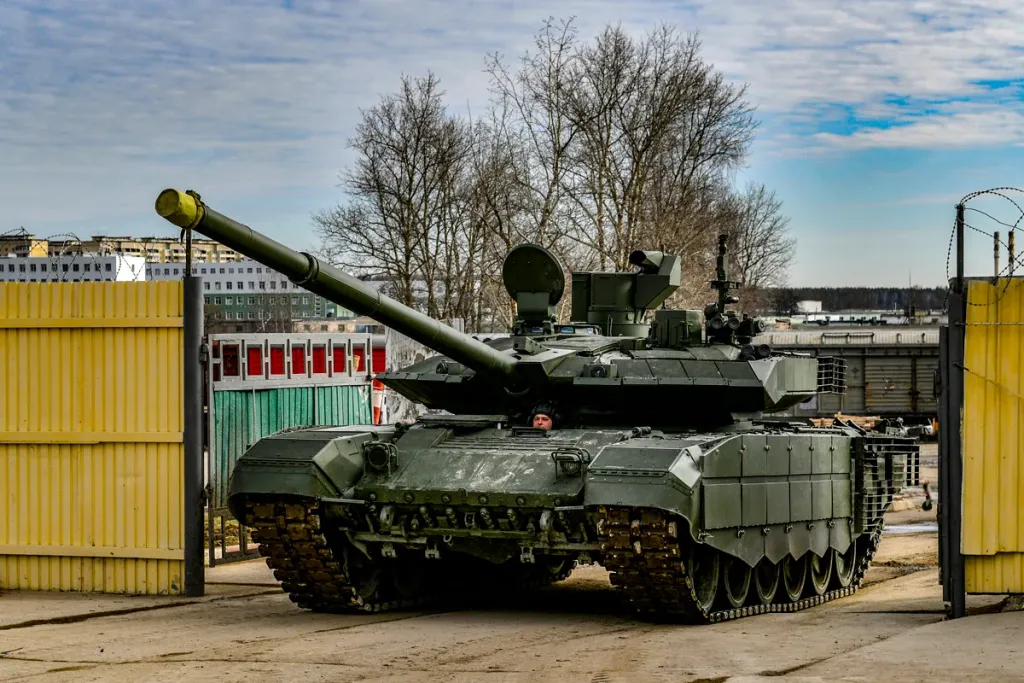
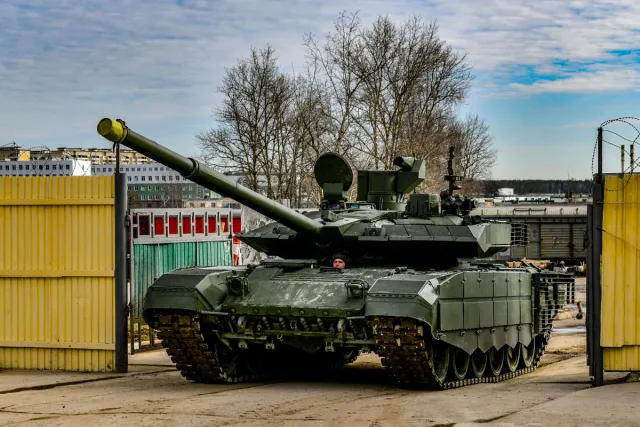
Via Wikipedia, T-90 (shown for identification)
The M1A2 SEP v3 Abrams has the worst power-to-weight ratio of the three, at 22.5 hp/tonne, despite tying the Type 99A for the single most powerful engine in the group. That’s not an engineering failure, it’s the direct, arithmetic consequence of the Abrams being the heaviest tank here by a wide margin: 66,800 kg against 58,000 kg for the Type 99A and just 48,000 kg for the T-90M. Horsepower is a fixed number on a spec sheet. Power-to-weight is what you get once you divide that number by everything the tank is actually carrying, and the Abrams carries more.
What do the numbers actually say?
| System | Country | Combat weight | Engine power | Power-to-weight | Main gun |
|---|---|---|---|---|---|
| M1A2 SEP v3 Abrams | United States | 66,800 kg | 1,500 hp | 22.5 hp/t | 120 mm M256A1 smoothbore |
| T-90M | Russia | 48,000 kg | 1,130 hp | 23.5 hp/t | 125 mm 2A46M-5 smoothbore (autoloaded) |
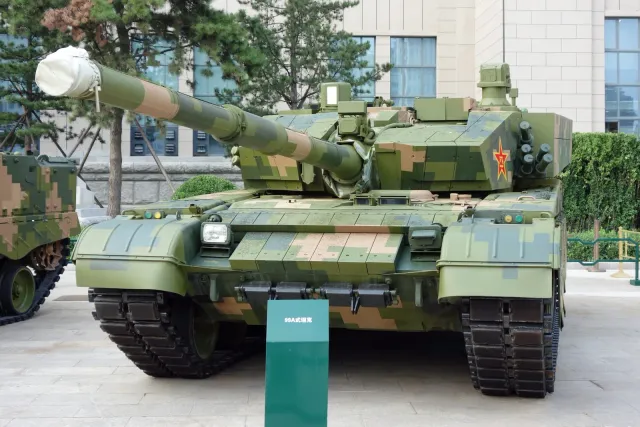
| Type 99A | China | 58,000 kg | 1,500 hp | 25.9 hp/t | 125 mm smoothbore with autoloader |
Three different answers to the same question. The T-90M has the smallest engine of the group at 1,130 hp, but it’s hauling the least weight, so its power-to-weight still edges out the Abrams. The Type 99A matches the Abrams horsepower-for-horsepower at 1,500 hp, but does it in a hull nearly 9 tonnes lighter, which puts it on top of the ranking. The Abrams brings the most raw power to the fight and finishes last on the one ratio that determines acceleration, hill climb, and how a tank handles under load.
Why does the Abrams carry so much extra weight?
Two things drive it, and both are choices, not accidents. First, armor. The M1A2 SEP v3’s composite package includes depleted-uranium-reinforced armor inserts in the frontal turret and glacis, a material the U.S. Army has used since the original M1A1 HA variant because of its density and effectiveness against kinetic penetrators. That density comes at a mass cost the T-90M and Type 99A don’t pay in the same way, since neither is known to field depleted-uranium armor arrays.
Second, crew layout. The Abrams keeps a four-person crew, commander, gunner, driver, and a human loader who manually racks 120 mm rounds into the M256A1 breech. Both the T-90M and Type 99A instead run autoloaders, dropping to a three-person crew and a smaller turret basket. An autoloader removes a body and the space that body needs to move, load, and stow ammunition by hand. The Abrams keeps that human loader deliberately, U.S. armor doctrine has long treated a human loader as more adaptable under stress and less prone to the jamming failures that have historically dogged Russian-pattern carousel autoloaders, plus it puts an extra set of hands and eyes in the turret if something breaks. It’s a tradeoff of weight and crew size against magazine reliability and turret-basket safety, and the Abrams’s numbers here are the direct bill for that choice.
Does the T-90M’s power-to-weight edge mean it’s the better tank?
Not by itself, and this is where the numbers need a caveat. The T-90M genuinely does the power-to-weight math best between itself and the Abrams, lighter chassis, smaller engine, still a better ratio. That’s real arithmetic, not spin. But armor composition, fire-control performance, and combat effectiveness claims for the T-90M come almost entirely from Russian manufacturer and state sources, Uralvagonzavod and Rosoboronexport chief among them, with limited independent verification. Combat footage from Ukraine since 2022 has produced competing claims about T-90-series survivability that neither side’s numbers alone can settle. A favorable power-to-weight ratio tells you about mobility potential, not about whether the armor behind that mobility holds up.
How does the Type 99A fit into this picture?
The Type 99A posts the best power-to-weight of the three, 25.9 hp/t, by matching the Abrams’s 1,500 hp engine in a hull nearly 9 tonnes lighter. That’s a legitimate design achievement if the published figures hold, China built a tank with the same raw power as the U.S. Army’s frontline MBT while shedding a meaningful fraction of its mass. But the same sourcing caveat applies here with even less independent corroboration than the T-90M gets. The Type 99A has no confirmed combat record, so there’s no battlefield data set, footage, loss claims, captured-vehicle inspections, to weigh against the spec sheet. Every number in this comparison for the Type 99A originates from China’s defense-industrial complex and state media, and should be read as an assertion the manufacturer wants believed, not an independently measured fact.
So which one wins?
None of them, because they’re not optimizing for the same thing. The Abrams trades power-to-weight for crew safety and a heavier armor package, a philosophy that prioritizes surviving a hit over accelerating away from one. The T-90M chases a lighter, autoloaded chassis that gets more mobility out of a smaller engine, a philosophy built around economy and crew reduction. The Type 99A tries to have it both ways, matching the Abrams’s horsepower while staying closer to the T-90M’s weight class, at least according to figures nobody outside China’s procurement system has independently verified. Power-to-weight is one axis. It tells you how a tank accelerates and climbs, not how it survives, not how its crew fights it under fire, and not whether the manufacturer’s numbers match what shows up on a battlefield.
Run your own comparison
If you want to weigh the Abrams against the T-90M directly, spec against spec, the Abrams vs T-90M comparison tool lays out both platforms side by side. For the wider field of main battle tanks, browse the full tank class page, or run your own mission priorities through the Advisor if you’re trying to figure out which design philosophy actually fits your use case. More head-to-head breakdowns like this one live on the WeaponSpecs articles page.
Systems in this comparison
Every system covered above, with its photo and, where available, a video. Tap a card to open the full spec sheet.
Compare these side by side →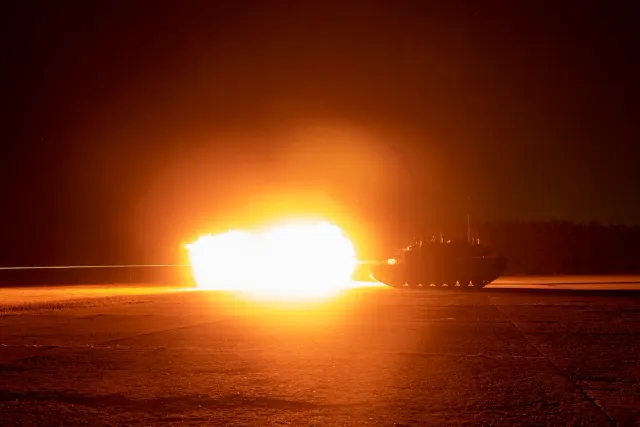
Frequently asked questions
Which tank has the best power-to-weight ratio: Abrams, T-90M, or Type 99A? +
On paper, the Type 99A leads at 25.9 hp/t, followed by the T-90M at 23.5 hp/t, with the M1A2 SEP v3 Abrams last at 22.5 hp/t. The gap isn't about engine strength, the Abrams and Type 99A both run 1,500 hp powerplants. It's about weight. The Abrams carries roughly 19 tonnes more than the T-90M and nearly 9 tonnes more than the Type 99A.
Why is the Abrams so much heavier than the T-90M and Type 99A? +
Mainly armor and crew configuration. The M1A2 SEP v3 carries a depleted-uranium-reinforced composite armor package that adds substantial mass over the T-90M and Type 99A's steel-composite arrays, and it retains a four-person crew with a human loader rather than an autoloader, which means a larger turret and hull to house that extra crew station. Both are deliberate design choices, not oversights.
Do the T-90M and Type 99A use autoloaders, and does the Abrams? +
Yes, both the T-90M and Type 99A use autoloaders for their 125 mm smoothbore guns, cutting crew size to three. The Abrams keeps a human loader on its 120 mm M256A1, running a four-person crew. The tradeoff is well documented: autoloaders save weight and crew exposure but have historically raised ammunition-safety and reliability questions in Russian-pattern carousel designs, while a human loader adds bulk and a body in the turret but is generally considered more flexible and less prone to jamming under stress.
How reliable are Russian and Chinese figures for the T-90M and Type 99A compared to the Abrams? +
Treat all three as claims, but weight the skepticism differently. Abrams specifications are disclosed through U.S. Army procurement documents and have some public audit trail. T-90M armor composition and fire-control performance figures come almost entirely from Russian state and manufacturer sources (Uralvagonzavod, Rosoboronexport) with limited independent verification, particularly post-2022 combat performance. Type 99A specifications are similarly state-sourced through China's defense-industrial complex, with even less independent combat data available. The 1,500 hp and 58,000 kg figures for the Type 99A are widely repeated but not independently audited.
Have the Abrams, T-90M, or Type 99A seen combat, and does that change the comparison? +
The Abrams has extensive combat history going back to the 1991 Gulf War, with real-world loss and performance data from Iraq and, in Ukrainian service, since 2023. The T-90 family (earlier variants, not confirmed M-standard in large numbers) has seen combat in Syria and Ukraine, producing footage and loss claims contested by both sides. The Type 99A has no known combat record; everything about its real-world performance remains untested and state-asserted. Combat exposure doesn't crown a winner, but it does mean the Abrams and older T-90 variants have been stress-tested in ways the Type 99A has not.
Related reading