F-35 vs Su-57: Which Fifth-Gen Fighter Wins?
F-35 vs Su-57: the F-35 wins on stealth, sensor fusion, and combat record; the Su-57 wins on paper agility.
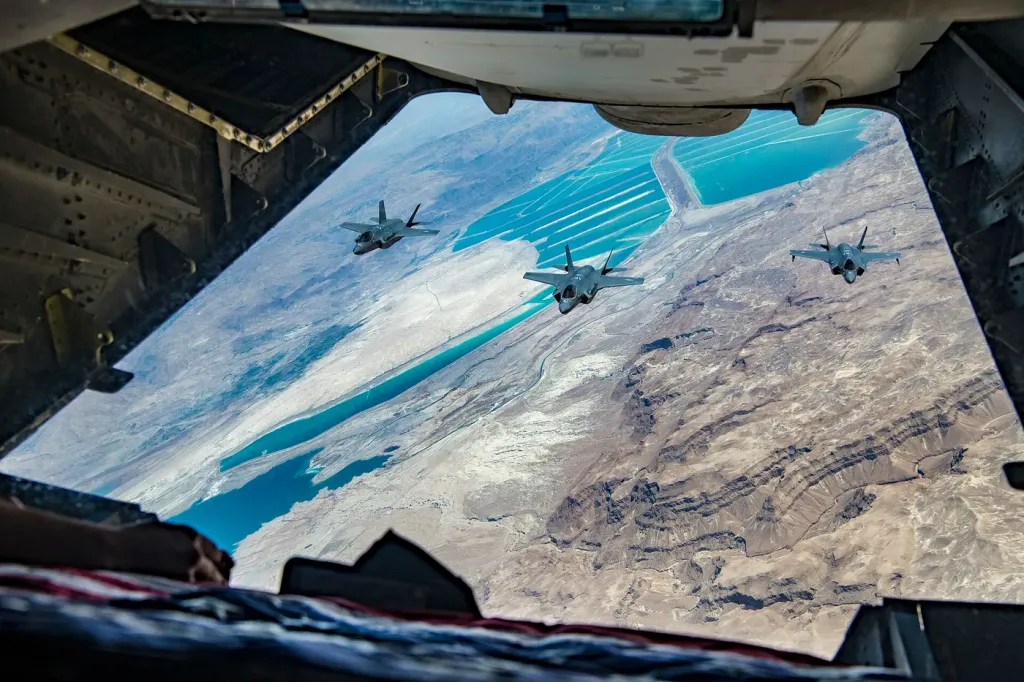
Master Sgt. Patrick O'Reilly, Public domain
The F-35 wins the fifth-generation fighter argument, and it isn’t close, not because it out-turns the Su-57, but because fifth-gen combat was never supposed to be decided by a knife fight. Stealth, sensor fusion, and networked situational awareness are the actual criteria, and on all three the F-35 has verified performance and a combat record; the Su-57 has marketing claims and a production run that never materialized. That doesn’t make the Su-57 irrelevant, its raw aerodynamic performance is real and its supermaneuverability is not in dispute, but “better fighter” and “wins the mission” are different questions, and this comparison is about the second one.
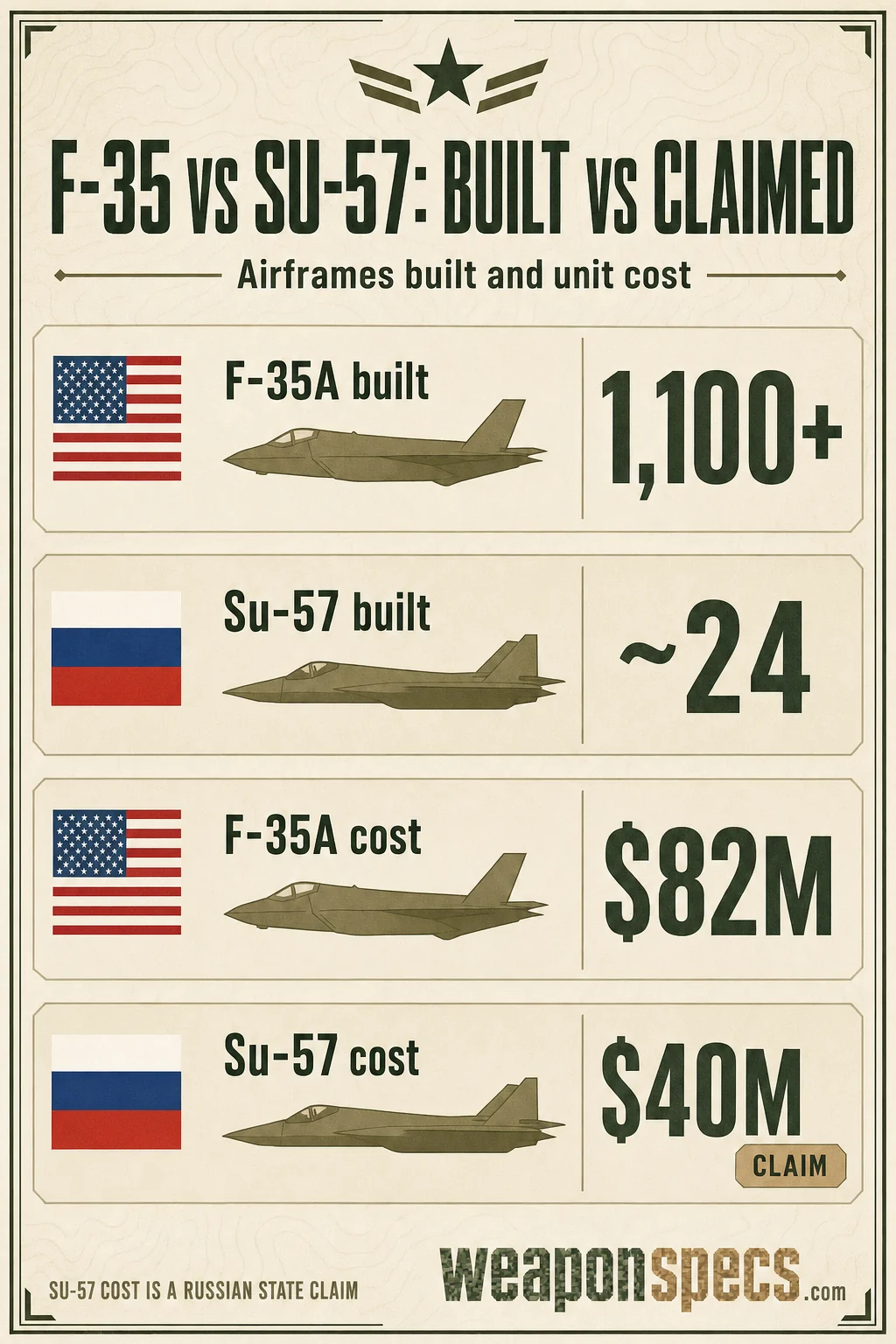
The doctrine gap: stealth-and-fusion vs. agility
Lockheed Martin built the F-35 around a simple bet: a pilot who sees first and shoots first wins, and stealth plus sensor fusion is how you guarantee that. The jet’s AN/APG-81 AESA radar, the Distributed Aperture System (DAS), and the Electro-Optical Targeting System (EOTS) all feed a single fused picture to the pilot’s helmet, rather than a set of separate displays to interpret manually. That fusion, publicly documented by the U.S. Air Force and Lockheed, is arguably the F-35’s single biggest edge, it’s a sensor-and-data platform that happens to carry weapons.
Sukhoi took a different bet with the Su-57: preserve the traditional Russian strength in high-alpha maneuverability, thrust-vectoring engines, extreme angle-of-attack handling, while adding partial stealth shaping and internal weapons bays. Publicly available airshow footage backs up the maneuverability claims; the stealth claims are harder to independently confirm.
Stealth: shaping vs. verified low observability
This is where the comparison gets uncomfortable for Su-57 boosters. The F-35’s radar cross-section is classified but widely estimated by Western defense analysts at a small fraction of a legacy fighter’s, achieved through consistent edge alignment, radar-absorbent coatings, and internal weapons carriage validated across more than a decade of flight testing.
The Su-57 uses similar design logic, internal bays, some edge alignment, but retains visible engine nozzles, protruding sensor fairings, and a fuselage that multiple independent defense analysts (not just Western critics) have flagged as compromising all-aspect stealth. Russian officials have claimed low-observable performance publicly, but there is no independent verification of Su-57 RCS figures, and the aircraft has reportedly relied on jamming and stand-off weapons rather than penetrating contested airspace in its limited combat use.
Sensors and weapons: fusion vs. suite
- F-35: AN/APG-81 AESA radar, DAS (360-degree infrared tracking), EOTS, and Multifunction Advanced Data Link (MADL) for low-probability-of-intercept networking with other F-35s.
- Su-57: The Sh121 sensor suite, including N036 AESA radar arrays and an L-band array in the wing leading edges intended partly as an anti-stealth aid, plus a distributed infrared search-and-track (IRST) system.
- F-35 weapons: Internal bays typically carry AIM-120 AMRAAMs and AIM-9X or, for strike, JDAMs/GBU-series bombs; a 25mm GAU-22/A cannon (internal on the A-model).
- Su-57 weapons: Internal bays reportedly sized for R-77 and R-74 air-to-air missiles plus various guided munitions, with a 30mm GSh-30-1 cannon; publicly reported hypersonic-capable weapons integration remains contested and not independently verified.
- Networking: The F-35’s MADL/Link 16 combination gives coalition-wide sensor sharing; the Su-57’s datalink and networked-operations claims are far less documented in open sources.
Both use internal carriage to preserve a low-observable profile, but the F-35’s sensor fusion architecture is the more mature, better-documented system by a wide margin.
The numbers, side by side
| Category | F-35A Lightning II | Su-57 Felon |
|---|---|---|
| Max speed | ~Mach 1.6 | ~Mach 2.0 (publicly claimed) |
| Combat radius | ~1,090 km | ~1,200 km (manufacturer claim) |
| Stealth | Verified low-observable, mature program | Partial shaping; independent verification limited |
| Sensors | APG-81 AESA + DAS + EOTS, full fusion | N036 AESA + IRST (Sh121 suite), fusion less documented |
| Primary weapons | AIM-120, AIM-9X, JDAM; 25mm cannon | R-77, R-74; 30mm cannon (reported) |
| Unit cost (approx.) | ~$80–90M flyaway (publicly disclosed) | ~$35–50M+ (Russian state claims, unverified) |
| Units built (2026) | 1,100+ across US and partners | Low dozens (public tracking estimates) |
Every Su-57 figure above should be read with an asterisk: it originates from Russian state media, manufacturer statements, or export-pitch materials with no independent third-party audit trail. The F-35 numbers are backed by Pentagon budget documents, GAO reports, and years of allied-nation procurement disclosures.
Production and combat record: the numbers Russia can’t spin
Here’s the part that doesn’t require nuance. The F-35 program has delivered more than 1,100 aircraft to the U.S. and a growing list of partner and customer nations, backed by a global sustainment network and a supply chain that’s been stress-tested for over a decade. The Su-57 was originally supposed to be in the hundreds by now; public tracking puts actual delivered airframes in the low dozens, a gap serious enough that even Russian aviation commentators have acknowledged production bottlenecks.
Combat exposure follows the same pattern. Israeli F-35I aircraft have flown strike packages across multiple contested fronts and, per public Israeli Air Force statements, penetrated sophisticated integrated air defenses. U.S. F-35s have logged real-world sorties in Middle East operations. The Su-57, by contrast, has been reported flying stand-off strike missions from within Russian airspace during the Ukraine war, launching weapons from a distance rather than operating inside contested airspace, which is precisely the scenario a genuine stealth fighter is designed to survive. That’s not proof the airframe can’t do it; it’s the absence of proof that it has.
Where the Su-57 actually has a case
None of this means the Su-57 is a paper tiger. Its supermaneuverability, powered by thrust-vectoring engines, is a real and demonstrated capability that the F-35, designed as a sensor-fusion strike fighter first, dogfighter second, doesn’t try to match. In a visual-range furball, the Su-57’s agility is a genuine asset. The problem for Russia is that modern air combat doctrine, validated repeatedly in exercises and the limited real-world data available, increasingly avoids the visual-range furball altogether in favor of beyond-visual-range engagements decided by whoever detects the other first.
The bottom line
The F-35 wins this comparison on the metrics that actually decide fifth-generation air combat: verified stealth, mature sensor fusion, a networked combat cloud, a real production run past 1,100 jets, and an actual combat record across multiple theaters. The Su-57 wins on raw aerodynamic bravado and claimed agility that nobody seriously disputes, but agility isn’t the game fifth-gen fighters were built to play, and Russia’s own production numbers suggest the program hasn’t yet delivered on its own ambitions.
Don’t take a columnist’s word for it, run the F-35A Lightning II vs. Su-57 breakdown yourself on WeaponSpecs, cross-check it against the fighter jet class field, or let the Advisor tool weigh the tradeoffs against your own mission profile. For more heads-up comparisons like this one, browse the WeaponSpecs articles.
Systems in this comparison
Every system covered above, with its photo and, where available, a video. Tap a card to open the full spec sheet.
Compare these side by side →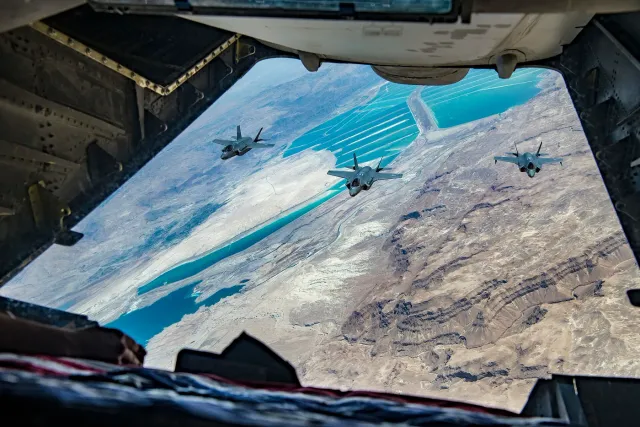
Fighter aircraft
F-35A Lightning II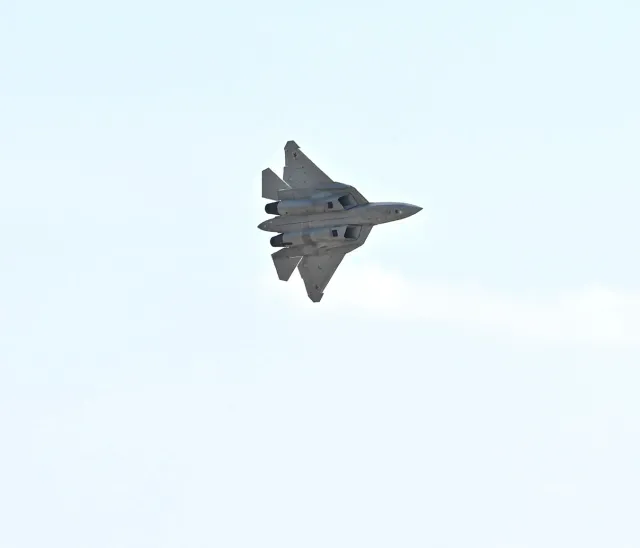
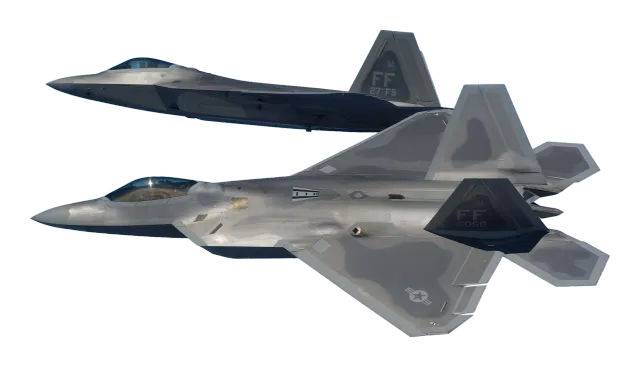
Fighter aircraft
F-22A RaptorFrequently asked questions
Is the F-35 better than the Su-57? +
For the mission fifth-gen fighters are actually built around, first-look, first-shot air combat via stealth and sensor fusion, yes. The F-35 has combat missions, 1,100+ jets built, and a networked sensor suite. The Su-57 has neither the production run nor the verified stealth to match.
Is the Su-57 truly stealth? +
Partially. Its shaping reduces frontal radar cross-section, but exposed engine nozzles, visible fasteners, and a coating regime with no independent verification suggest a materially larger RCS than the F-35. Analysts generally rate it closer to a 'stealthy' 4.5-gen jet than a true low-observable design.
How much does each cost? +
The F-35A runs roughly $80-90 million flyaway under current Lot pricing, publicly disclosed by the Pentagon. The Su-57's price is murkier, Russian state figures and export pitches have cited numbers from about $35 million to $50 million-plus, unverified by independent audit.
Has the F-35 seen combat? +
Yes, extensively. Israeli F-35Is have flown strike missions over multiple fronts, and U.S. F-35s have supported operations in the Middle East. The Su-57's combat exposure is limited to reported stand-off strikes in Ukraine from Russian airspace, avoiding contested airspace entirely.
How many Su-57s have been built? +
Publicly tracked estimates put Su-57 production in the low dozens as of 2026, far behind original Russian targets. The F-35 program, by contrast, has delivered more than 1,100 airframes across the US and partner air forces.
Related reading