How Much Does a Fighter Jet Really Cost?
Fighter jet cost breakdown: flyaway price vs full lifecycle cost, why O&S eats 70% of the budget, and how the F-35 compares to rivals.
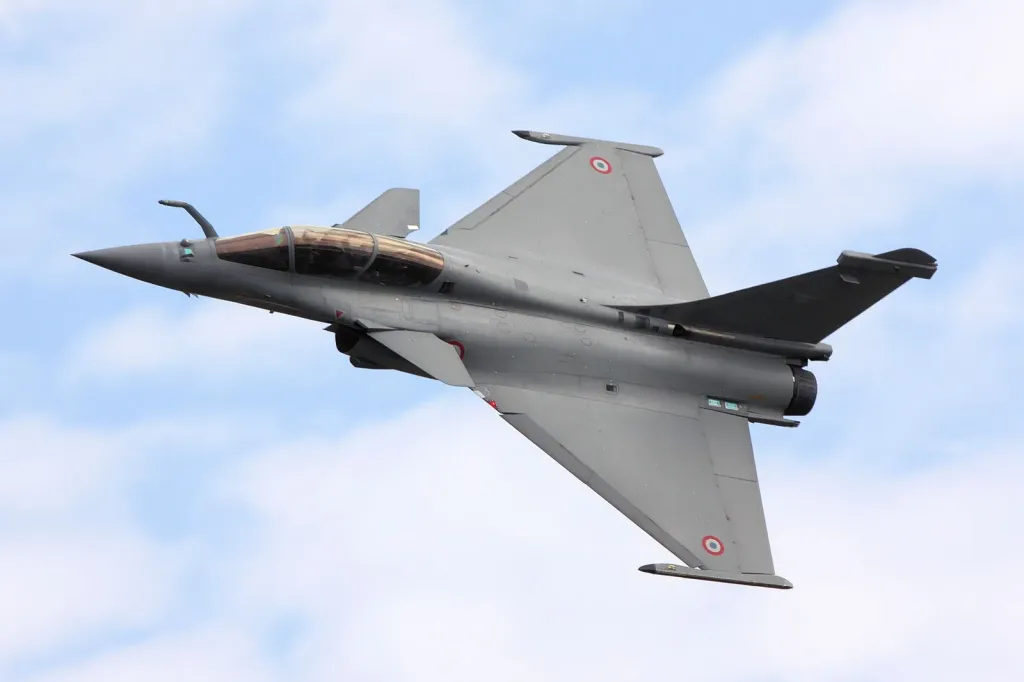
Via Wikipedia, Dassault Rafale (shown for identification)
How much does a fighter jet cost?
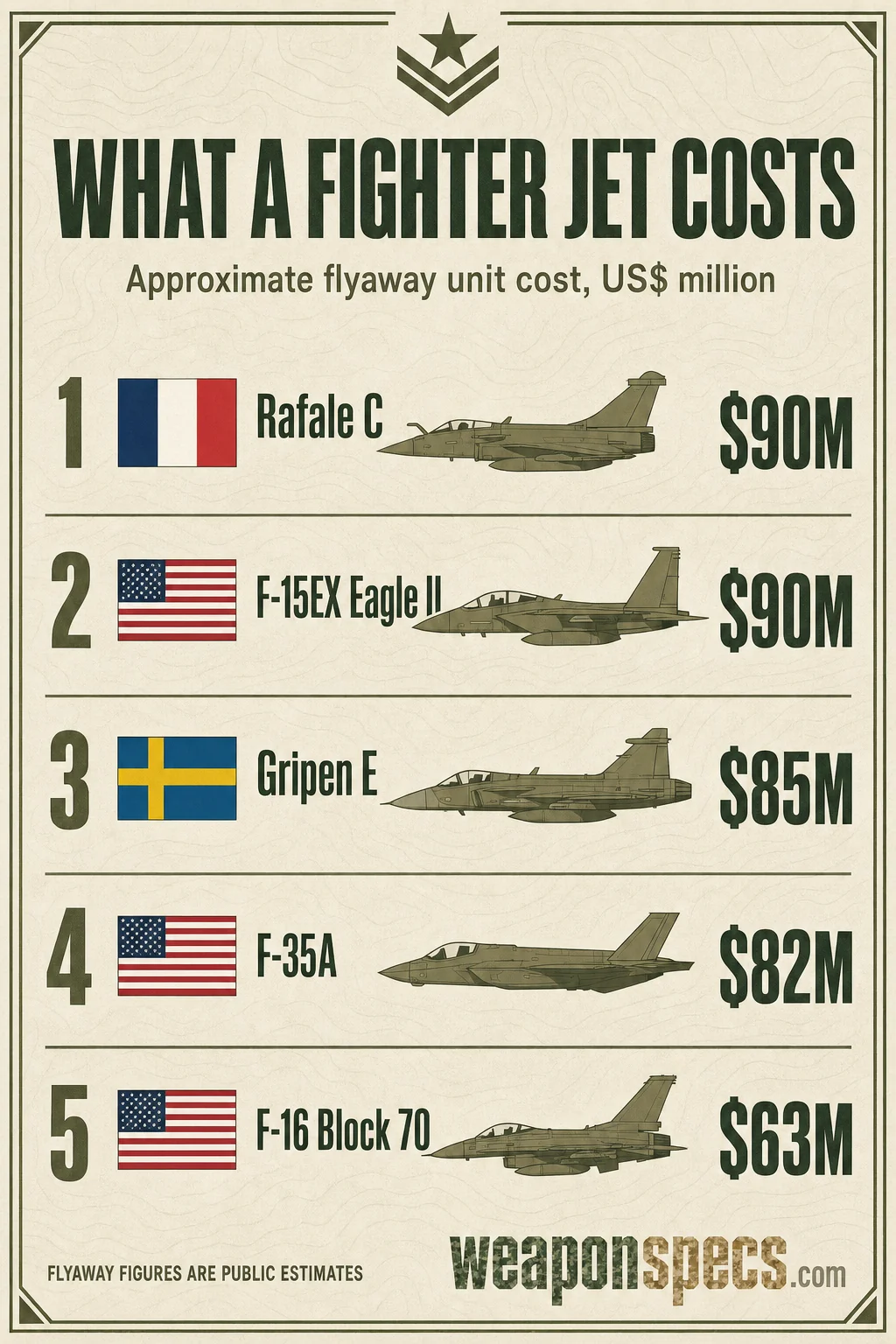
Here’s the number everyone wants and almost nobody gets right: a modern fighter’s flyaway unit cost runs somewhere between $63 million and $95 million-plus depending on type and lot. That’s the sticker price for one jet rolling off the line, airframe, engine, avionics, done. It is not what the jet actually costs a government over its service life. Factor in decades of fuel, maintenance, spare parts, upgrades, and the personnel who keep it flying, and the lifecycle cost per airframe climbs into the hundreds of millions, sometimes exceeding the original purchase price several times over. If you’ve seen wildly different headline numbers for the “cost of an F-35,” this flyaway-versus-lifecycle gap is almost always why.
Public defense budgets don’t make this easy to parse. Contract values get reported in different fiscal years, different lot sizes, and different currencies. What follows is a straight breakdown of what you’re actually paying for, hedged where the public numbers disagree, because they often do.
Flyaway cost: the number in the headlines
Flyaway cost is the closest thing to a sale price a fighter has. It typically includes:
- Airframe structure and assembly
- Engine(s)
- Mission avionics and radar
- Standard factory-fitted systems
It usually does not include weapons, spares, initial training, or the ground infrastructure needed to actually operate the jet. Two governments can buy “the same” fighter and report different flyaway costs because they’re in different production lots, different currencies, or bundling different options.
| Fighter | Approx. flyaway unit cost |
|---|---|
| F-35A Lightning II | ~$82M |
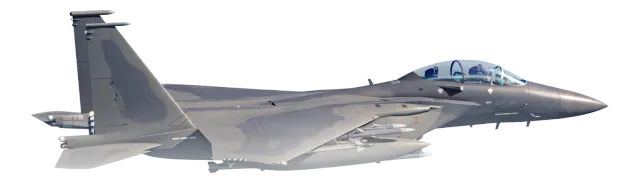
| F-15EX Eagle II | ~$90M |
| Rafale C | ~$90M+ |
| Gripen E | ~$85M |
| F-16 Block 70 | ~$63M |
These are approximate, publicly reported figures and move with production lot, exchange rates, and negotiated offset packages, treat them as ballpark, not quotes. The F-16 Block 70’s lower flyaway cost reflects its single-engine, non-stealth design and a mature, decades-long production line; the newer or stealth-oriented designs carry a premium for low-observable materials, sensor fusion, or twin-engine redundancy.
Program cost: what the flyaway number leaves out
Program cost, sometimes called “program acquisition unit cost”, is the figure the GAO and defense auditors actually care about, because it reflects what a buy really costs the taxpayer per airframe. It adds:
- Research, development, test, and evaluation (RDT&E) amortized across the production run
- Tooling and factory setup
- Simulators and training systems
- Initial spares packages
- Contractor support during fielding
Program cost is consistently and substantially higher than flyaway cost, for major fighter programs it can run 20-40% above the flyaway figure, sometimes more in early production lots before economies of scale kick in. Early buyers of any new fighter program pay a premium baked into this gap; it’s why unit costs on programs like the F-35 have trended down over successive lots as R&D gets spread across more airframes.
Operating and support: the number nobody puts on a poster
This is the part that actually breaks defense budgets. According to GAO analysis of major weapons systems, operating and support (O&S) costs make up roughly 70% of a fighter’s total lifecycle cost, the acquisition price, flyaway or program, is the smaller slice of the pie over a 30-plus-year service life.
O&S includes:
- Fuel and consumables
- Scheduled and unscheduled maintenance
- Spare parts and depot-level repair
- Software and capability upgrades
- Personnel, pilots, maintainers, and support crews
- Cost per flight hour, tracked and reported (often imperfectly) across fleets
This is exactly where the F-35 has drawn the most scrutiny. Its stealth coatings need specialized low-observable maintenance, its software-heavy sensor fusion demands more contractor support, and its logistics pipeline (ALIS/ODIN) has been a recurring subject of GAO and Pentagon cost-per-flight-hour reporting. Estimates have put F-35A cost-per-flight-hour in the $30,000-$40,000 range against roughly $22,000-$27,000 for legacy F-16s, figures that shift depending on fiscal year, fleet maturity, and what’s counted as “support.” Compare that to a design like the Gripen E, built from the outset around low parts-count maintainability and quick turnaround, and the O&S gap between platforms can be as consequential as the flyaway price difference, arguably more so, since it repeats every year for three decades.
Why the same jet gets reported at different prices
A few reasons headline numbers for “the same” fighter contradict each other:
- Lot number, unit costs fall as production matures and fixed costs get spread wider
- Currency and offsets, export deals often bundle local-industry offsets that distort the sticker price
- What’s included, engines, weapons, and spares are sometimes counted, sometimes not
- Fiscal year dollars, inflation-adjusted vs then-year dollars produce different headline figures
- Source, government budget documents, GAO reports, and manufacturer statements don’t always agree
None of this is a conspiracy, it’s just that “cost” is doing three different jobs (flyaway, program, lifecycle) in the same sentence, and reporters and even official documents don’t always specify which one they mean.
What this means for buyers and taxpayers
For an air force deciding what to fly next, the flyaway number is almost a rounding error against the real question: can the country afford to operate this jet for three decades? A cheaper flyaway price with a bloated O&S profile can end up costing more than a pricier jet with a lean sustainment footprint. This is part of why some air arms have specifically favored single-engine, mechanically simpler designs for cost-sensitive fleets, while others accept the O&S premium of stealth and sensor fusion because the capability gap is judged worth it.
It’s also why multinational programs negotiate so hard over sustainment contracts, not just unit prices. A government locked into a single-source parts and software pipeline has limited leverage to control O&S growth over the life of the fleet, a dynamic that has shown up repeatedly in GAO reporting on major fighter programs. Buyers increasingly ask for transparent cost-per-flight-hour benchmarks and competitive sustainment options before signing, precisely because the acquisition price is the easy part of the negotiation.
The bottom line
Flyaway cost tells you what a jet costs to build. Program cost tells you what a buy costs to acquire. Neither tells you what a fighter actually costs a government over 30 years of service, and that’s the number that matters most for anyone comparing platforms seriously, since O&S is roughly 70% of the total bill. If you’re evaluating fighters side by side, don’t stop at the headline price tag.
Run the numbers yourself in the Advisor, which factors in estimated lifecycle cost alongside mission fit, or start with the fighter jet category to see how these platforms stack up on paper. Curious how the F-35A and F-16 Block 70 compare directly? Check the head-to-head comparison. For more breakdowns like this, see the WeaponSpecs articles.
Systems in this comparison
Every system covered above, with its photo and, where available, a video. Tap a card to open the full spec sheet.
Compare these side by side →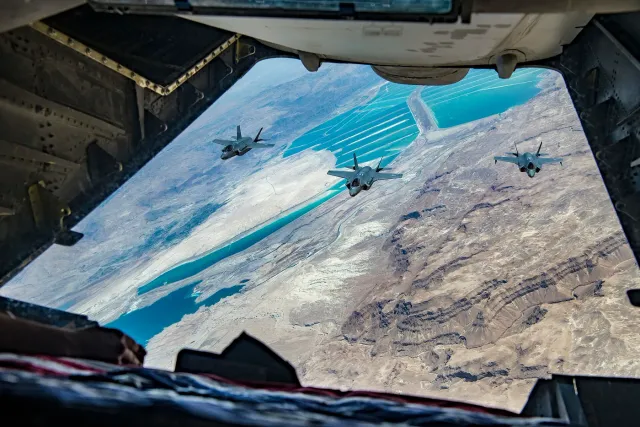
Fighter aircraft
F-35A Lightning II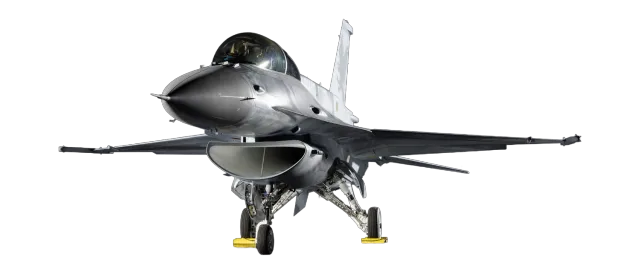
Fighter aircraft
F-16C Block 70/72 Fighting Falcon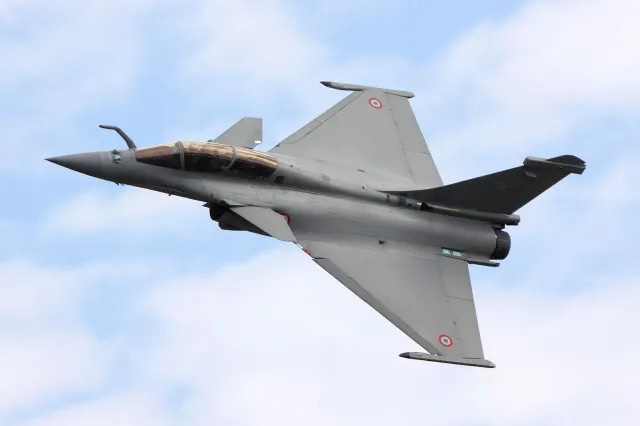
Fighter aircraft
F-15EX Eagle II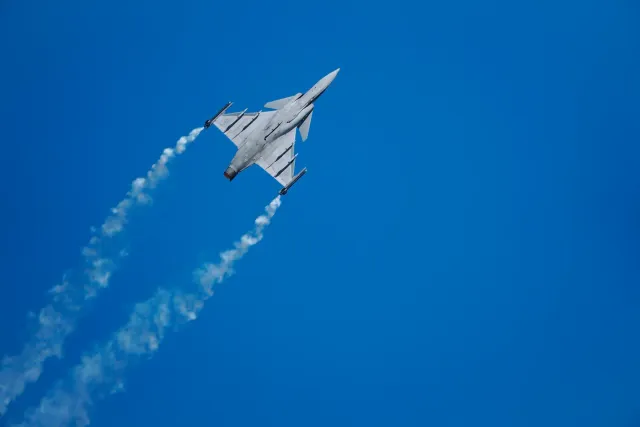
Fighter aircraft
JAS 39E GripenFrequently asked questions
How much does a fighter jet cost? +
A modern fighter's flyaway unit cost runs roughly $63M to $95M+ depending on type, but that figure excludes engines, weapons integration, and support. Counting decades of operating and support spending, the true lifecycle cost per aircraft typically runs into the hundreds of millions of dollars.
What is flyaway cost vs program cost? +
Flyaway cost covers the airframe, engine, and avionics needed for one jet to leave the factory and fly. Program cost adds R&D, tooling, spares, simulators, and infrastructure spread across the whole buy, it's a materially larger per-unit figure than flyaway alone.
Why is the F-35 so expensive to operate? +
The F-35's stealth coatings, sensor fusion software, and low-observable maintenance require specialized depots, more contractor labor, and costly parts logistics. The Pentagon's own cost-per-flight-hour tracking has repeatedly shown the F-35A above its original affordability targets.
What is the cost per flight hour of a fighter? +
Public and GAO estimates put F-35A cost-per-flight-hour in the $30,000-$40,000 range versus roughly $22,000-$27,000 for legacy F-16s, though figures vary by source, fiscal year, and what overhead is included.
Which fighter is cheapest to own? +
Among current-production Western fighters, the Gripen E is generally cited as the lowest lifecycle-cost option, reflecting Saab's design-for-maintainability approach and lower operating-hour costs versus stealth or twin-engine designs.
Related reading